While I'm as sick of the billionaire way to run the world as the next guy, I don't really see what scanlation has to do with the issues mentioned here. The problem is clearly in the original source, more specifically, the author's writing chops. The best editor on Earth isn't going to solve that, he'd have to write the story for him. No editor can make the author willing to invest his time and effort into improving his knowledge on the topic of his work either and there are many who can't be arsed to learn the first thing. It's true that the scanlation community has devolved into a shameful shadow of what it had been, which is the direct cause of the abysmal quality of it these days. This is an old debate though and it has been settled years ago: people decided they don't mind paying for crap and attracting more and more shysters looking for a quick buck, as long as you tell them it's "supporting the community", even though the number one rule has always been both scanlation and enjoying the result should be purely hobbies.I a
Agreed! And it is precisely because of the rentier finance capitalist hijacking of the industry, mass consolidation, and assembly line stratification of the industries [from webcomics to Manga style comics to western comics] that has led to this extreme systematic enshitification of the industry, which is the no. one factor for why the quality of comics has diminished so considerably over time. Nurturing editors are a fossil of an extinct species that was wiped out by rentier finance capitalists demanding ever more extreme extraction. When firms put all the capital or the majority into extractive measures all the way along form advertising on down in classical magazine publications where the vast majority of print advertising revenue goes to oligarchs and monopolies like Alphabet, Meta, etc., and then what's left over is further stratified for private equity, etc., extraction, there is almost nothing if not nothing left to actually maintain the quality of the product, the very reason people are no longer willing to shell out for "official translations" because what was a criticism of some firms has now become the definitive norm, leaving the often best quality translations to independent, relic/legacy scanlation/fanlation groups, all while the vast majority of translations are being scooped up by the young idiots who have chosen to mimic the very toxic, exploitative, rentier finance capitalist exploitation enshitificaiton assembly line to become the very thing that they or previous generations spent great length of print griping about ad nauseam.
You are using an out of date browser. It may not display this or other websites correctly.
You should upgrade or use an alternative browser.
Yaraare-yaku no Akutoku Kojin-inchou ni Tensei Shita Ore, Main Heroine no Musume-tachi ni Suka rete Shimau - Ch. 3
- Thread starter MangaDex
- Start date
Double-page supporter
- Joined
- Mar 9, 2019
- Messages
- 918
While I'm as sick of the billionaire way to run the world as the next guy, I don't really see what scanlation has to do with the issues mentioned here. The problem is clearly in the original source, more specifically, the author's writing chops. The best editor on Earth isn't going to solve that, he'd have to write the story for him. No editor can make the author willing to invest his time and effort into improving his knowledge on the topic of his work either and there are many who can't be arsed to learn the first thing. It's true that the scanlation community has devolved into a shameful shadow of what it had been, which is the direct cause of the abysmal quality of it these days. This is an old debate though and it has been settled years ago: people decided they don't mind paying for crap and attracting more and more shysters looking for a quick buck, as long as you tell them it's "supporting the community", even though the number one rule has always been both scanlation and enjoying the result should be purely hobbies.
(Part 1 of 5 — Note: The TL;DR summary is located right here at the beginning; Parts 2, 3, 4, 5, and an Optional Part 6 on the Cooperative Alternative follow below.)
TL;DR: The Complete Structural Chain (Macro to Micro)
If you want the entire plot summarized in one rapid-fire breakdown of how rentier capitalism destroyed the creative and scanlation ecosystems, here is the chain of reasoning:
- 1. The Root Pathogen (Rentier Finance Capitalism): Dynastic publishing oligarchies and financial elites prioritize IP hoarding, debt leverage, and unearned rent extraction over productive investment in human labor.
- 2. Macro-Level Extraction: Massive wealth drains, technofeudal cloud fiefdoms (Alphabet, Meta), and production committees capture billions in creator surplus value, enforcing artificial scarcity and precarity.
- 3. Chokepoint Capitalism & Enshittification: Platforms and publishers lock creators and readers into walled gardens, slashing artist royalties and flooding the market with low-risk, disposable content.
- 4. The Death of Editing & Assembly-Line Burnout: Developmental editors are liquidated as "overhead," leaving creators stranded on 14-hour daily workweeks with zero research time—making algorithmic trope slop the only way to survive a weekly quota.
- 5. The Scanlation Betrayal (Imprinting the Rat Race): Younger generations entering the scanlation scene under gig-economy poverty severed ties with the original DEFCON/hacker anarcho-eco-techno-socialist-communalist commons.
- 6. Control Fraud & Gresham's Dynamic: Rather than acting as an ethical bypass that funnels funds back to starving creators, commercialized scanlation groups adopted the exact rentier extractivism they were built to fight—replicating sweatshops, sniping ethical groups, and locking stolen work behind paywalls.
- 7. The AI Prompt-Mill Ouroboros: Both corporate publishers and rogue scanlation shysters are now deploying raw Machine Translation (MTL) and AI prompt-mills to eliminate human labor entirely—trapping workers in 12-hour shifts while tech monopolies scrape the fan commons to train future AI replacements.
- Conclusion: Slop is not an "author writing chops" issue; it is the mathematically guaranteed output of a rentier machine. Blaming creators or scanlators while ignoring the macro-financial system feeds the very beast destroying art.
I’m dropping this comprehensive structural map here not just to untangle this specific thread, but because I keep seeing this exact surface-level debate pop up over and over again. Having been around these digital and political trenches for years—from early grassroots organizing, founding the Portland Metro Greens, and independent journalism (such as documenting civil liberties and community actions on YouTube via @Dragoon91786) to working behind the scenes as an independent editor and consultant with comic artists, web-novelists, and manhuajia—I've had to look firsthand at the actual backend contracts these digital publishing firms hand out. I want to lay out the mechanical plumbing of why both the source industry and the scanlation scene have rotted into assembly-line slop.
The Map Is Not the Territory: Why Blaming "Individual Writing Chops" Ignores a Century of Rentier Extraction, Control Fraud, and Platform Enshittification
When you argue that "the problem is clearly in the original source, more specifically the author's writing chops" and that "the best editor on Earth isn't going to solve that," you are looking at the final, exhausted output at the bottom of an industrial meat grinder and blaming the meat for how it was ground. As Alfred Korzybski established through General Semantics a century ago, the map is not the territory—evaluating an isolated downstream symptom while ignoring the multi-ordinal, macroeconomic environment that produced it guarantees a false conclusion.
Furthermore, when you state "I don't really see what scanlation has to do with the issues mentioned here," you are treating the degradation of source publishing and the degradation of fan scanlation as two unrelated coincidences—when in reality, they are two mirrors of the exact same macroeconomic pathogen: the triumph of Rentier Finance Capitalism, Chokepoint Capitalism, and Criminogenic Control Fraud over productive, high-wage creative labor and the digital commons.
To follow the actual plot of how the industry was broken—and how that exact corporate rot imprinted itself onto the scanlation community—examine the three visual maps below, followed by the structural breakdown.
Visual Maps: The Macro & Micro Extraction Loops
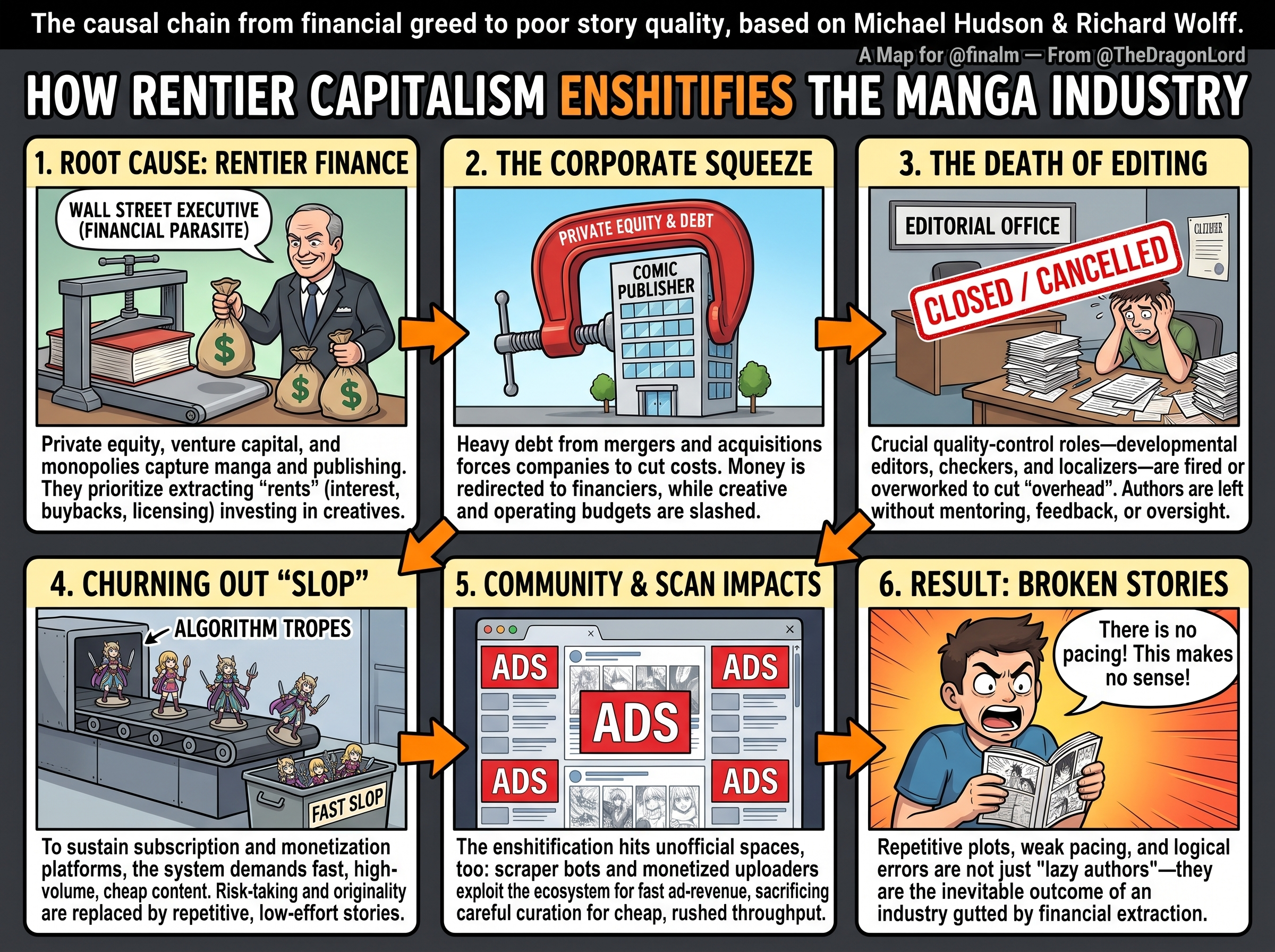
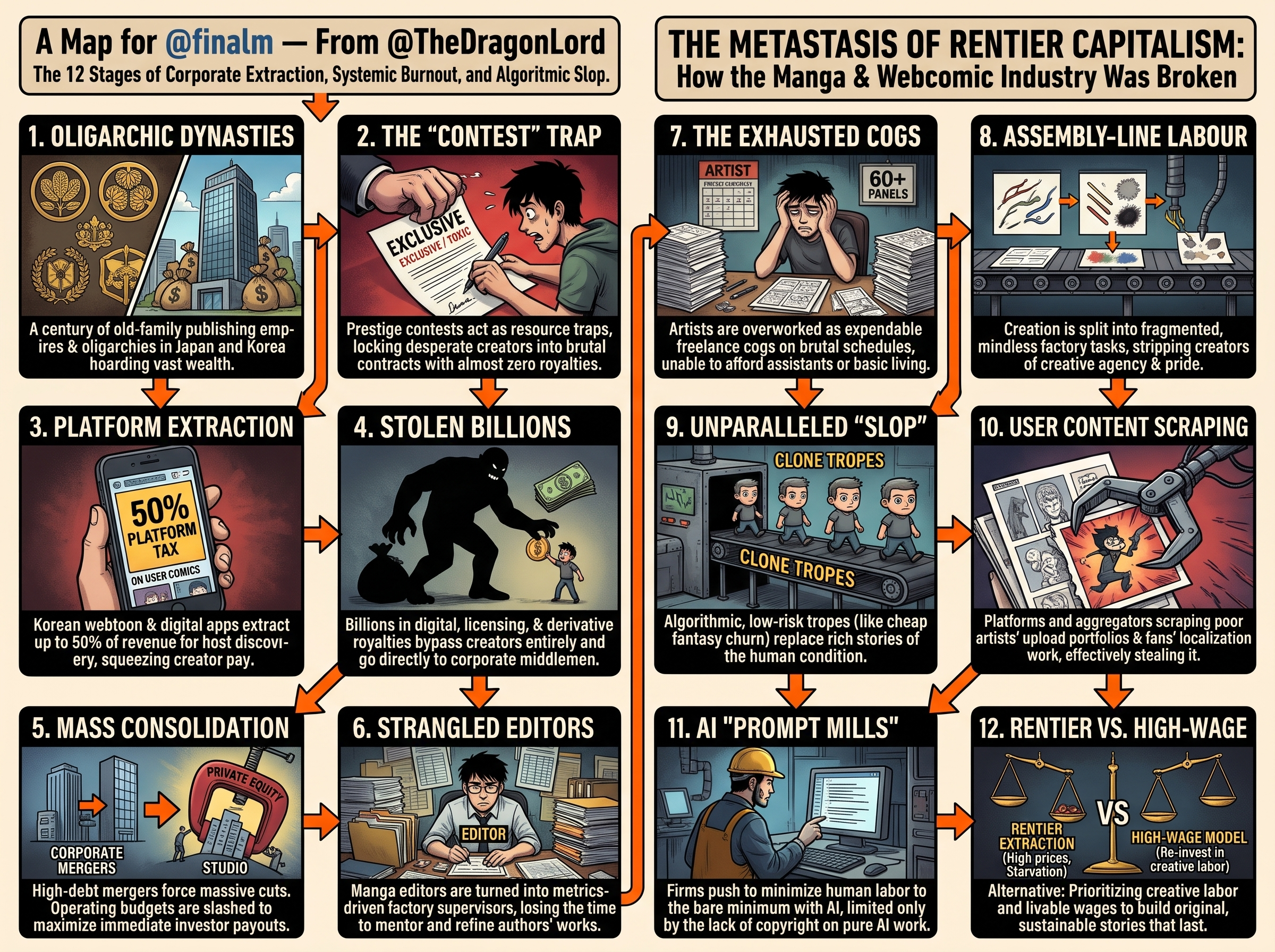
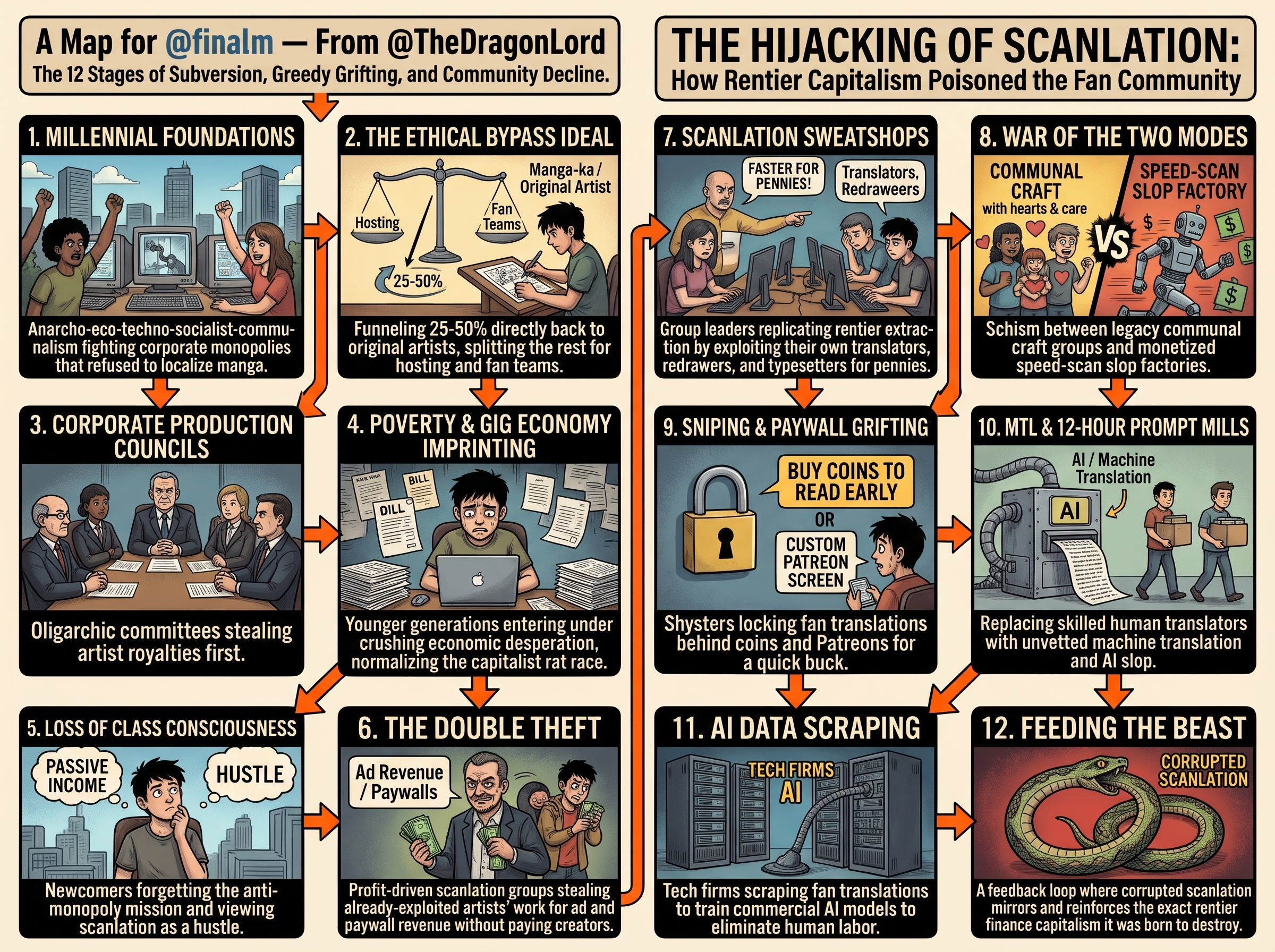
Last edited:
Double-page supporter
- Joined
- Mar 9, 2019
- Messages
- 918
(Part 2 of 5 — Continued from Part 1 above)
Part I: Cory Doctorow's "Enshittification," Chokepoint Capitalism, and the Murder of Developmental Editing
To claim that an editor cannot help an author research, pace, structure, or elevate a narrative unless they "write the story for him" fundamentally misunderstands both what developmental editing was before finance capital gutted publishing houses, and how modern platform monopolies operate.
Author and digital rights activist Cory Doctorow coined the exact term for this decay: Enshittification—the three-stage lifecycle by which rentier platforms and media conglomerates die:
In a healthy creative ecosystem, a developmental editor is not a mere spell-checker or schedule-enforcer; they are an institutional mentor, dramaturg, and structural architect. During the golden eras of publishing, editors worked alongside creators to challenge weak premises, compile historical or technical research dossiers, enforce narrative pacing, and give authors the breathing room required to craft meaningful stories about the human condition. Thorstein Veblen famously described this as the battle between the instinct of workmanship (artists, writers, editors, craftspeople) and predatory pecuniary vested interests (financiers and absentee owners who sabotage production to maintain monopoly pricing).
Why are nurturing editors an extinct species today?
Part I: Cory Doctorow's "Enshittification," Chokepoint Capitalism, and the Murder of Developmental Editing
To claim that an editor cannot help an author research, pace, structure, or elevate a narrative unless they "write the story for him" fundamentally misunderstands both what developmental editing was before finance capital gutted publishing houses, and how modern platform monopolies operate.
Author and digital rights activist Cory Doctorow coined the exact term for this decay: Enshittification—the three-stage lifecycle by which rentier platforms and media conglomerates die:
- Stage 1 (Allocation to Users/Creators): Platforms and publishers initially offer viable terms, discovery, or editorial support to attract creators and lock in audiences.
- Stage 2 (Abusing Users/Creators to Serve Business Customers): Once audiences and artists are locked into the ecosystem, the firm squeezes creators—slashing page rates, stripping royalties, and flooding spaces with algorithmic promotions—to extract rents from advertisers and corporate partners.
- Stage 3 (Total Extraction for Rentier Shareholders): Finally, the firm withdraws all value from both creators and readers to funnel maximum short-term yield to private equity, venture capital, and oligarchic shareholders. The platform becomes a hollowed-out pile of slop held together only by Chokepoint Capitalism (as documented by Doctorow and Rebecca Giblin)—where monopoly gatekeepers lock audiences and artists inside walled gardens so creators have no bargaining power and must accept below-subsistence wages.
In a healthy creative ecosystem, a developmental editor is not a mere spell-checker or schedule-enforcer; they are an institutional mentor, dramaturg, and structural architect. During the golden eras of publishing, editors worked alongside creators to challenge weak premises, compile historical or technical research dossiers, enforce narrative pacing, and give authors the breathing room required to craft meaningful stories about the human condition. Thorstein Veblen famously described this as the battle between the instinct of workmanship (artists, writers, editors, craftspeople) and predatory pecuniary vested interests (financiers and absentee owners who sabotage production to maintain monopoly pricing).
Why are nurturing editors an extinct species today?
- The Siphoning of Publishing Revenue into Tech-Rentier Fiefdoms: Over the past two decades, legacy print and digital magazine advertising revenue was swallowed whole by tech oligopolies and monopolies (Alphabet, Meta, etc.) operating what economist Yanis Varoufakis calls Technofeudalism—replacing traditional markets with digital cloud-fiefdoms that charge massive rent just to reach an audience.
- The Liquidation of Editorial Overhead: What revenue remains after Big Tech takes its cut is raided by private equity, M&A debt-service, and conglomerate dividend mandates. To hit extractive targets, firms slashed editorial departments to the bone. Today's editors are overworked factory floor supervisors juggling dozens of simultaneous titles. They lack the time, budget, or institutional mandate to help an author research a topic or rewrite a flawed draft.
- The Survival Rat Race of the Modern Creator: You blame authors who "can't be arsed to learn the first thing" or invest time into their craft. With what time? And with what resources? Under Chokepoint Capitalism, writers and artists are treated as expendable freelance cogs working 14-to-18-hour days under crushing weekly panel and word-count quotas, unable to afford assistants or basic financial security. Having inspected these contracts firsthand across various web-publishing platforms, I can tell you that creators fall back on pre-packaged, algorithmic tropes (isekai, status-window fantasy, villainess reincarnation templates) because trope-shorthand is the only mathematically viable way to survive a weekly assembly-line quota without dying at the desk.
Last edited:
Double-page supporter
- Joined
- Mar 9, 2019
- Messages
- 918
(Part 3 of 5 — Continued from Part 2 above)
Part II: Classical Political Economy, Japan's Oligarchic Dynasties, MMT, and Macro-Financial Extraction
This crisis is not a new moral failing; it is the culmination of over a hundred years of entrenched oligarchic family dynasties in Japan (such as the Hitotsubashi Group—Shueisha, Shogakukan, Hakusensha—and the Otowa Group/Kodansha) alongside South Korean chaebol-backed platform monopolies (Naver, Kakao) fusing traditional feudal patronage with Western financialization.
To comprehend the scale of this extraction, you have to look at the macroeconomic corpus:
How This Plays Out Inside the Manga & Webcomic Machine:
Part II: Classical Political Economy, Japan's Oligarchic Dynasties, MMT, and Macro-Financial Extraction
This crisis is not a new moral failing; it is the culmination of over a hundred years of entrenched oligarchic family dynasties in Japan (such as the Hitotsubashi Group—Shueisha, Shogakukan, Hakusensha—and the Otowa Group/Kodansha) alongside South Korean chaebol-backed platform monopolies (Naver, Kakao) fusing traditional feudal patronage with Western financialization.
To comprehend the scale of this extraction, you have to look at the macroeconomic corpus:
- Michael Hudson & Classical Political Economy (Rent vs. Profit): As Michael Hudson (alongside scholars like Radhika Desai, Dirk Bezemer, and Mariana Mazzucato) demonstrates, classical economists from Adam Smith to John Stuart Mill and Karl Marx sought to free economies from economic rent—unearned income extracted simply by owning a monopoly asset (land, debt, IP copyrights, or distribution platforms) without contributing productive labor. Modern Rentier Finance Capitalism inverted this: the FIRE sector (Finance, Insurance, Real Estate) and IP monopolies extract maximum rent while starving the real economy of wages and productive reinvestment.
- Steve Keen & Stock-Flow Consistent (SFC) Debt Deflation: As Post-Keynesian economist Steve Keen proves through non-equilibrium stock-flow consistent modeling (via Minsky), when rentiers and financial institutions extract compounding claims on income faster than the productive economy pays out in wages, purchasing power collapses and workers are forced into chronic precarity and debt servitude.
- Richard D. Wolff & Surplus Value Theft: As Richard Wolff (and Stephen Resnick) detail, inside hierarchical corporate structures, the vast majority of the surplus value generated by creative workers is appropriated by boards of directors, shareholders, and licensing committees, leaving the actual producers with a tiny fraction of the wealth their art creates.
- Stephanie Kelton (MMT) vs. Catherine Austin Fitts & Mark Skidmore (The Macro-Drain): While Stephanie Kelton, Warren Mosler, L. Randall Wray, and Modern Monetary Theory (MMT) prove that sovereign currency-issuing nations face real-resource constraints rather than artificial revenue scarcity, neoliberal policy enforces brutal austerity on working people and artists. Meanwhile, as economist Mark Skidmore and former Assistant HUD Secretary Catherine Austin Fitts documented in their forensic audits of over $21 Trillion in unaccounted federal fiscal adjustments, massive trillions are systematically siphoned out of the transparent, productive civilian economy into unaccountable oligarchic capital pools and technocratic control grids. The poverty crushing working artists and readers is not an accident of nature; it is engineered macro-extraction.
How This Plays Out Inside the Manga & Webcomic Machine:
- The "Production Committee" (Seisaku Iinkai) Cartel: Oligarchic consortia lock studios and creators into meager upfront flat fees while hoarding 90%+ of downstream global licensing, streaming, and merchandising profits.
- Billions Stolen at the Top, Starvation at the Bottom: Even generational titans like Eiichiro Oda (One Piece) have had tens of billions of dollars in global franchise surplus captured by corporate rightsholder committees rather than returning to the creative teams. And if that is the starting line for the most successful mangaka in history, everyone beneath that level is subjected to outright peonage.
- Predatory "Contests" and Web-Portal Scraping: Newcomer contests and amateur portals (Shousetsuka ni Narou, KakaoPage, Webtoon Canvas) operate as what David Harvey calls Accumulation by Dispossession—enclosing user-generated creative labor as free corporate R&D, scraping starving artists' portfolios for algorithmic trends, and locking winners into draconian exclusive contracts where digital platforms take a 50%+ platform cut while working artists into physical disability.
- The High-Wage Alternative: Contrast this with the High-Wage, High-Investment Productive Model: when creators, editors, and assistants are paid high livable wages, retain cooperative equity/royalties in their IP, and receive institutional time for research and development, the high floor of labor compels firms to compete on artistic mastery, narrative depth, and enduring quality rather than high-volume disposable churn.
Last edited:
Double-page supporter
- Joined
- Mar 9, 2019
- Messages
- 918
(Part 5 of 5 — Continued from Part 4 above; Optional Part 6 follows below)
Part IV: The Complete 45-Point General Semantics & Political Economy Causal Map
Part V: Essential Corpus & Reference Bibliography
Conclusion
You cannot separate the rot in the source material from the rot in the scanlation scene, nor can you reduce either of them to individual moral failings like "bad writing chops" or isolated "shysters." When an economic system is engineered from top to bottom to extract maximum rent while starving the human beings who actually write, draw, edit, and translate the art, slop is not an accident—it is the mathematically guaranteed output of the machine.
Part IV: The Complete 45-Point General Semantics & Political Economy Causal Map
PHASE I: MACROECONOMIC EXTRACTION, OLIGARCHY & CONTROL FRAUD
[1] Century-Old Publishing Oligarchies: Dynastic publishing cartels in Japan (Hitotsubashi/Otowa empires) and chaebol platform monopolies in Korea establish gatekeeping control over cultural production.
⬇
[2] Classical Rent vs. Productive Labor (Michael Hudson): Rentier finance capitalism overtakes industrial capitalism; the FIRE sector and IP cartels extract unearned economic rent rather than reinvesting in labor.
⬇
[3] Macro-Level Capital Drain (Catherine Austin Fitts & Mark Skidmore): Trillions in public and productive wealth (over $21T in unaccounted fiscal flows) are siphoned into oligarchic pools, imposing austerity on working people.
⬇
[4] Artificial Monetary Scarcity (Stephanie Kelton / MMT): Despite sovereign currency capacity, neoliberal policy enforces wage suppression on the creative class while subsidizing corporate consolidation.
⬇
[5] Debt Deflation & Purchasing Power Collapse (Steve Keen): As modeled in Post-Keynesian SFC economics (Minsky), compounding rentier claims drain circular wage flows, forcing artists and readers into precarity.
⬇
[6] Technofeudal Cloud Fiefdoms (Yanis Varoufakis): Tech monopolies (Alphabet, Meta, Amazon) swallow traditional advertising revenues, replacing markets with digital fiefdoms extracting cloud rents.
⬇
[7] Surplus Value Appropriation (Richard D. Wolff): Corporate boards and investor consortia appropriate nearly all surplus value generated by creative workers, alienating artists from their labor and IP.
⬇
[8] The "Production Committee" (Seisaku Iinkai) Cartel: Financing councils structure contracts so middlemen capture backend royalties while locking studios and creators into starvation flat-rate budgets.
⬇
[9] Billions Stolen from Even Flagship Creators: Even generational titans (One Piece) have tens of billions in global derivative value extracted by committees—setting a brutal baseline for entry-level creators.
PHASE II: ENSHITTIFICATION, CHOKEPOINT CAPITALISM & THE DEATH OF EDITING
[10] Chokepoint Capitalism (Cory Doctorow & Rebecca Giblin): Monopoly platforms lock creators and readers inside walled gardens, eliminating bargaining power and driving pay below subsistence.
⬇
[11] Accumulation by Dispossession (David Harvey) via Contests & Portals: Contests and web-portals act as unpaid corporate R&D farms, harvesting starving artists' concepts into predatory exclusive contracts.
⬇
[12] The 50%+ Platform Tax & Portfolio Scraping: Digital apps extract 50%+ of gross revenue for hosting while algorithmically scraping amateur uploads to clone trends for free.
⬇
[13] Three-Stage Platform Enshittification (Cory Doctorow): Firms shift from supporting creators (Stage 1) to squeezing creators for partners (Stage 2) to stripping all value for shareholders (Stage 3).
⬇
[14] Veblenian Sabotage of Workmanship (Thorstein Veblen): Financial executives treat careful research, narrative craft, and developmental mentorship as obstacles to rapid quarterly extraction.
⬇
[15] Extinction of the Nurturing Developmental Editor: Conglomerates liquidate experienced developmental editors as "overhead," severing the mentorship that elevated flawed drafts into masterpieces.
⬇
[16] Editors Reduced to Metrics-Driven Factory Supervisors: Remaining editors are overloaded with dozens of titles, enforcing deadlines, demanding clickbait, and axing slow-burn stories.
PHASE III: THE ASSEMBLY-LINE COG & SOURCE-MATERIAL "SLOP"
[17] Starvation Page Rates & Zero Assistant Budgets: Falling real wages and platform cuts leave creators unable to afford assistants or basic stability.
⬇
[18] The 60–80+ Panel Weekly Death March: Creators face physically destructive weekly quotas, resulting in hospitalization, tendonitis, and severe cognitive burnout.
⬇
[19] Taylorist Assembly-Line Fragmentation: Studios splinter creation into alienated piece-work (scriptors, 3D-asset pasters, line-artists, color-flatters) with zero unified artistic soul.
⬇
[20] Elimination of Research & Worldbuilding Time: Paid strictly by speed and panel volume, taking weeks to study history, science, or prose craft becomes economic suicide.
⬇
[21] Mandatory Algorithmic Trope Shorthand: Exhausted authors rely on pre-digested tropes (isekai cheat skills, status windows, villainess loops) that require zero editorial setup to churn out weekly.
⬇
[22] Abandonment of Stories About the Human Condition: Deep, challenging art about the human experience is filtered out in favor of low-friction dopamine loops.
⬇
[23] Rejection of the High-Wage / High-Quality Model: Instead of paying livable wages and royalties so well-rested teams build timeless works, the rentier machine enforces disposable slop.
PHASE IV: THE DEFCON / HACKER COMMONS IDEAL VS. CAPITALIST IMPRINTING
[24] The Anarcho-Eco-Techno-Socialist-Communalist Genesis: Older Millennials and Gen X pioneers built early scanlation out of the hacker/cypherpunk culture of DEFCON, CCC, HOPE, EFF, and Free Software.
⬇
[25] Adversarial Interoperability Against Monopolies: Early scanlation routed around greedy corporate gatekeepers that hoarded licenses, refused to localize art, or censored works.
⬇
[26] The Pure Craft & Public Commons Ethos: Scanlation was strictly non-commercial—uniting volunteers to preserve artistic integrity for free public access.
⬇
[27] The Road Not Taken (The 25–50% Ethical Bypass Model): In an authentic counter-economy, community revenue in unserved regions would funnel 25–50% directly back to original artists, splitting the rest between hosting and the fan team.
⬇
[28] Neoliberal Poverty & Gig-Economy Desperation: Crushed into precarity, younger generations entered the fandom desperate for income and conditioned by "hustle culture."
⬇
[29] Severance from Historical & Class Consciousness: Disconnected from DEFCON/anarcho-communalist roots, newcomers viewed scanlation as a gray-market monetization hustle.
⬇
[30] Psychological & Structural Imprinting of the Rat Race: The extractive ideology of rentier capitalism was copied directly onto the unofficial scanlation ecosystem.
PHASE V: DOUBLE THEFT, CONTROL FRAUD & GRESHAM'S DYNAMIC IN SCANLATION
[31] The First Theft (Corporate Oligarchs): Publishers and Production Committees rob the original mangaka/author of IP ownership, health, and billions in royalties.
⬇
[32] The Second Theft (Commercialized Scanlation Shysters): Profit-seeking scanlators take already-stolen labor, send $0 to the creator, and slap paywalls and ad networks onto it.
⬇
[33] Scanlation Sweatshops (Internalized Exploitation): Commercial group leaders hoard Patreon, coin, and ad revenues while paying student translators, cleaners, and typesetters piece-rate pennies.
⬇
[34] The Schism (War Between the Two Modes): Open conflict erupts between Mode A (legacy communal craft groups) and Mode B (for-profit speed-scan slop factories).
⬇
[35] Criminogenic Gresham's Dynamic (William K. Black): Unchecked control fraud creates a criminogenic environment where Mode B profit-shysters drive ethical Mode A groups out of the space.
⬇
[36] Predatory "Sniping" & Paywall Grifting: Mode B factories snipe popular series with rushed garbage, locking chapters behind "early-access coins" while claiming to "support the community."
⬇
[37] Burnout & Exile of Skilled Human Craft: Demoralized by snipers and paywall grifters, meticulous volunteer translators and redrawers burn out.
PHASE VI: 12-HOUR AI PROMPT MILLS, COPYRIGHT SHIELDING & THE OUROBOROS LOOP
[38] The Unvetted MTL Deluge: To cut even the pennies paid to translators, commercial scanlation farms automate chapters through raw AI/MTL pipelines.
⬇
[39] Corporate Push to Eliminate Human Capital: Official publishers and localization platforms deploy generative AI to eliminate human translators, letterers, and artists.
⬇
[40] The Statutory Copyright Monopoly Bottleneck: The only legal barrier stopping 100% human replacement is copyright law denying monopoly IP protection to purely AI-generated works without a "human in the loop."
⬇
[41] The Rise of 12-Hour AI Prompt Mills: To satisfy the nominal "human-in-the-loop" threshold, corporate farms and scanlation factories trap gig workers in 12-hour shifts rubber-stamping AI/MTL slop.
⬇
[42] Enclosing the Fan Commons for Corporate AI Training: Tech monopolies scrape decades of unpaid fan scanlations and artist portfolios to train commercial AI models to replace human workers.
⬇
[43] Total Enshittification of Reader Standards: Caught between unedited corporate trope-churn and garbled MTL speed-scans, audiences normalize broken pacing and incoherent prose.
⬇
[44] Corporate Pretext for Draconian Crackdowns: Mode B profiteering hands corporate monopolies the legal and PR ammunition for sweeping DMCA purges against the archival commons.
⬇
[45] Feeding the Beast (The Closed Ouroboros Loop): Abandoning anarcho-eco-techno-socialist-communalism for petty rent-seeking starves creators, accelerates AI replacement, and completes the conquest of art by rentier finance capitalism.
Part V: Essential Corpus & Reference Bibliography
- Cory Doctorow & Rebecca Giblin: The Internet Con; Chokepoint Capitalism; essays on Enshittification and Adversarial Interoperability.
- Michael Hudson: Killing the Host; J Is for Junk Economics; Super Imperialism; ...and Forgive Them Their Debts.
- Richard D. Wolff & Stephen Resnick: Democracy at Work: A Cure for Capitalism; Contending Economic Theories.
- Steve Keen: Debunking Economics; Can We Avoid Another Financial Crisis? (Post-Keynesian SFC modeling via Minsky).
- William K. Black: The Best Way to Rob a Bank is to Own One (Control Fraud, Criminogenic Environments, and Gresham's Dynamic).
- Stephanie Kelton & The MMT School (Mosler, Wray, Tcherneva, Mitchell): The Deficit Myth.
- Mark Skidmore & Catherine Austin Fitts: Forensic audits of the Missing $21+ Trillion in DOD/HUD fiscal adjustments (Missing Money / The Solari Report).
- David Harvey: The New Imperialism; A Brief History of Neoliberalism (Accumulation by Dispossession).
- Yanis Varoufakis: Technofeudalism: What Killed Capitalism.
- Thorstein Veblen: The Engineers and the Price System; The Theory of Business Enterprise.
- The Hacker, Cypherpunk & Digital Commons Ethos: Lectures and archives of DEFCON, CCC, HOPE, EFF, Aaron Swartz (Guerilla Open Access Manifesto), and FLOSS.
Conclusion
You cannot separate the rot in the source material from the rot in the scanlation scene, nor can you reduce either of them to individual moral failings like "bad writing chops" or isolated "shysters." When an economic system is engineered from top to bottom to extract maximum rent while starving the human beings who actually write, draw, edit, and translate the art, slop is not an accident—it is the mathematically guaranteed output of the machine.
Last edited:
Double-page supporter
- Joined
- Mar 9, 2019
- Messages
- 918
(Part 5A — Continued from Part 4 above; Part 5B [Complete Reference Bibliography] and Optional Part 6 [The Cooperative WSDE Alternative] follow below)
Part IV: The Complete 45-Point General Semantics & Political Economy Causal Map
Part IV: The Complete 45-Point General Semantics & Political Economy Causal Map
PHASE I: MACROECONOMIC EXTRACTION, OLIGARCHY & CONTROL FRAUD
[1] Century-Old Publishing Oligarchies: Dynastic publishing cartels in Japan (Hitotsubashi/Otowa empires) and chaebol platform monopolies in Korea establish gatekeeping control over cultural production.
⬇
[2] Classical Rent vs. Productive Labor (Michael Hudson): Rentier finance capitalism overtakes industrial capitalism; the FIRE sector and IP cartels extract unearned economic rent rather than reinvesting in labor.
⬇
[3] Macro-Level Capital Drain (Catherine Austin Fitts & Mark Skidmore): Trillions in public and productive wealth (over $21T in unaccounted fiscal flows) are siphoned into oligarchic pools, imposing austerity on working people.
⬇
[4] Artificial Monetary Scarcity (Stephanie Kelton / MMT): Despite sovereign currency capacity, neoliberal policy enforces wage suppression on the creative class while subsidizing corporate consolidation.
⬇
[5] Debt Deflation & Purchasing Power Collapse (Steve Keen): As modeled in Post-Keynesian SFC economics (Minsky), compounding rentier claims drain circular wage flows, forcing artists and readers into precarity.
⬇
[6] Technofeudal Cloud Fiefdoms (Yanis Varoufakis): Tech monopolies (Alphabet, Meta, Amazon) swallow traditional advertising revenues, replacing markets with digital fiefdoms extracting cloud rents.
⬇
[7] Surplus Value Appropriation (Richard D. Wolff): Corporate boards and investor consortia appropriate nearly all surplus value generated by creative workers, alienating artists from their labor and IP.
⬇
[8] The "Production Committee" (Seisaku Iinkai) Cartel: Financing councils structure contracts so middlemen capture backend royalties while locking studios and creators into starvation flat-rate budgets.
⬇
[9] Billions Stolen from Even Flagship Creators: Even generational titans (One Piece) have tens of billions in global derivative value extracted by committees—setting a brutal baseline for entry-level creators.
PHASE II: ENSHITTIFICATION, CHOKEPOINT CAPITALISM & THE DEATH OF EDITING
[10] Chokepoint Capitalism (Cory Doctorow & Rebecca Giblin): Monopoly platforms lock creators and readers inside walled gardens, eliminating bargaining power and driving pay below subsistence.
⬇
[11] Accumulation by Dispossession (David Harvey) via Contests & Portals: Contests and web-portals act as unpaid corporate R&D farms, harvesting starving artists' concepts into predatory exclusive contracts.
⬇
[12] The 50%+ Platform Tax & Portfolio Scraping: Digital apps extract 50%+ of gross revenue for hosting while algorithmically scraping amateur uploads to clone trends for free.
⬇
[13] Three-Stage Platform Enshittification (Cory Doctorow): Firms shift from supporting creators (Stage 1) to squeezing creators for partners (Stage 2) to stripping all value for shareholders (Stage 3).
⬇
[14] Veblenian Sabotage of Workmanship (Thorstein Veblen): Financial executives treat careful research, narrative craft, and developmental mentorship as obstacles to rapid quarterly extraction.
⬇
[15] Extinction of the Nurturing Developmental Editor: Conglomerates liquidate experienced developmental editors as "overhead," severing the mentorship that elevated flawed drafts into masterpieces.
⬇
[16] Editors Reduced to Metrics-Driven Factory Supervisors: Remaining editors are overloaded with dozens of titles, enforcing deadlines, demanding clickbait, and axing slow-burn stories.
PHASE III: THE ASSEMBLY-LINE COG & SOURCE-MATERIAL "SLOP"
[17] Starvation Page Rates & Zero Assistant Budgets: Falling real wages and platform cuts leave creators unable to afford assistants or basic stability.
⬇
[18] The 60–80+ Panel Weekly Death March: Creators face physically destructive weekly quotas, resulting in hospitalization, tendonitis, and severe cognitive burnout.
⬇
[19] Taylorist Assembly-Line Fragmentation: Studios splinter creation into alienated piece-work (scriptors, 3D-asset pasters, line-artists, color-flatters) with zero unified artistic soul.
⬇
[20] Elimination of Research & Worldbuilding Time: Paid strictly by speed and panel volume, taking weeks to study history, science, or prose craft becomes economic suicide.
⬇
[21] Mandatory Algorithmic Trope Shorthand: Exhausted authors rely on pre-digested tropes (isekai cheat skills, status windows, villainess loops) that require zero editorial setup to churn out weekly.
⬇
[22] Abandonment of Stories About the Human Condition: Deep, challenging art about the human experience is filtered out in favor of low-friction dopamine loops.
⬇
[23] Rejection of the High-Wage / High-Quality Model (Hudson's "American School"): Instead of paying livable wages and royalties so well-rested teams build timeless works, the rentier machine enforces Ricardian low-wage disposable slop.
PHASE IV: THE DEFCON / HACKER COMMONS IDEAL VS. CAPITALIST IMPRINTING
[24] The Anarcho-Eco-Techno-Socialist-Communalist Genesis: Older Millennials and Gen X pioneers built early scanlation out of the hacker/cypherpunk culture of DEFCON, CCC, HOPE, EFF, and Free Software.
⬇
[25] Adversarial Interoperability Against Monopolies: Early scanlation routed around greedy corporate gatekeepers that hoarded licenses, refused to localize art, or censored works.
⬇
[26] The Pure Craft & Public Commons Ethos: Scanlation was strictly non-commercial—uniting volunteers to preserve artistic integrity for free public access.
⬇
[27] The Road Not Taken (The 25–50% Ethical Bypass Model): In an authentic counter-economy, community revenue in unserved regions would funnel 25–50% directly back to original artists, splitting the rest between hosting and the fan team.
⬇
[28] Neoliberal Poverty & Gig-Economy Desperation: Crushed into precarity, younger generations entered the fandom desperate for income and conditioned by "hustle culture."
⬇
[29] Severance from Historical & Class Consciousness: Disconnected from DEFCON/anarcho-communalist roots, newcomers viewed scanlation as a gray-market monetization hustle.
⬇
[30] Psychological & Structural Imprinting of the Rat Race: The extractive ideology of rentier capitalism was copied directly onto the unofficial scanlation ecosystem.
PHASE V: DOUBLE THEFT, CONTROL FRAUD & GRESHAM'S DYNAMIC IN SCANLATION
[31] The First Theft (Corporate Oligarchs): Publishers and Production Committees rob the original mangaka/author of IP ownership, health, and billions in royalties.
⬇
[32] The Second Theft (Commercialized Scanlation Shysters): Profit-seeking scanlators take already-stolen labor, send $0 to the creator, and slap paywalls and ad networks onto it.
⬇
[33] Scanlation Sweatshops (Internalized Exploitation): Commercial group leaders hoard Patreon, coin, and ad revenues while paying student translators, cleaners, and typesetters piece-rate pennies.
⬇
[34] The Schism (War Between the Two Modes): Open conflict erupts between Mode A (legacy communal craft groups) and Mode B (for-profit speed-scan slop factories).
⬇
[35] Criminogenic Gresham's Dynamic (William K. Black): Unchecked control fraud creates a criminogenic environment where Mode B profit-shysters drive ethical Mode A groups out of the space.
⬇
[36] Predatory "Sniping" & Paywall Grifting: Mode B factories snipe popular series with rushed garbage, locking chapters behind "early-access coins" while claiming to "support the community."
⬇
[37] Burnout & Exile of Skilled Human Craft: Demoralized by snipers and paywall grifters, meticulous volunteer translators and redrawers burn out.
PHASE VI: 12-HOUR AI "REVERSE CENTAUR" PROMPT MILLS & THE OUROBOROS LOOP
[38] The Unvetted MTL Deluge: To cut even the pennies paid to translators, commercial scanlation farms automate chapters through raw AI/MTL pipelines.
⬇
[39] Corporate Push to Eliminate Human Capital: Official publishers and localization platforms deploy generative AI to eliminate human translators, letterers, and artists.
⬇
[40] The Statutory Copyright Monopoly Bottleneck: The only legal barrier stopping 100% human replacement is copyright law denying monopoly IP protection to purely AI-generated works without a "human in the loop."
⬇
[41] The Rise of 12-Hour AI "Reverse Centaur" Prompt Mills (Doctorow): To satisfy the nominal "human-in-the-loop" threshold, corporate farms and scanlation factories strap gig workers to machines in 12-hour shifts rubber-stamping AI/MTL slop.
⬇
[42] Enclosing the Fan Commons for Corporate AI Training: Tech monopolies scrape decades of unpaid fan scanlations and artist portfolios to train commercial AI models to replace human workers.
⬇
[43] Total Enshittification of Reader Standards: Caught between unedited corporate trope-churn and garbled MTL speed-scans, audiences normalize broken pacing and incoherent prose.
⬇
[44] Corporate Pretext for Draconian Crackdowns: Mode B profiteering hands corporate monopolies the legal and PR ammunition for sweeping DMCA purges against the archival commons.
⬇
[45] Feeding the Beast (The Closed Ouroboros Loop): Abandoning anarcho-eco-techno-socialist-communalism for petty rent-seeking starves creators, accelerates AI replacement, and completes the conquest of art by rentier finance capitalism.
Last edited:
While it's true that enshittification is a global, all-encompassing phenomenon, you are inventing things about the scanlation community that were never fact. I've been a part of it when it was still young and it was never any sort of "class conscious" agenda for standing against capitalism, exploitation or anything in particular, really. It MOST CERTAINLY didn't split any proceeds with the original authors, even if there was anything to split, they couldn't reach them if they wanted to and said authors always viewed the practise negatively, even when manga almost never left the Japanese markets, they wouldn't accept anything from them even if they could. Scanlators were hobbyists who liked bringing series they enjoyed to a wider audience. That's it. Trying to dress them up as some sort of underground resistence culture is laughable and drama about who "owns" what was common, even though they were all pirates.(Part 1 of 4 — Note: The TL;DR summary is located right here at the beginning; Parts 2, 3, and 4 follow below.)
TL;DR: The Complete Structural Chain (Macro to Micro)
If you want the entire plot summarized in one rapid-fire breakdown of how rentier capitalism destroyed the creative and scanlation ecosystems, here is the chain of reasoning:
- 1. The Root Pathogen (Rentier Finance Capitalism): Dynastic publishing oligarchies and financial elites prioritize IP hoarding, debt leverage, and unearned rent extraction over productive investment in human labor.
- 2. Macro-Level Extraction: Massive wealth drains, technofeudal cloud fiefdoms (Alphabet, Meta), and production committees capture billions in creator surplus value, enforcing artificial scarcity and precarity.
- 3. Chokepoint Capitalism & Enshittification: Platforms and publishers lock creators and readers into walled gardens, slashing artist royalties and flooding the market with low-risk, disposable content.
- 4. The Death of Editing & Assembly-Line Burnout: Developmental editors are liquidated as "overhead," leaving creators stranded on 14-hour daily workweeks with zero research time—making algorithmic trope slop the only way to survive a weekly quota.
- 5. The Scanlation Betrayal (Imprinting the Rat Race): Younger generations entering the scanlation scene under gig-economy poverty severed ties with the original DEFCON/hacker anarcho-eco-techno-socialist-communalist commons.
- 6. Control Fraud & Gresham's Dynamic: Rather than acting as an ethical bypass that funnels funds back to starving creators, commercialized scanlation groups adopted the exact rentier extractivism they were built to fight—replicating sweatshops, sniping ethical groups, and locking stolen work behind paywalls.
- 7. The AI Prompt-Mill Ouroboros: Both corporate publishers and rogue scanlation shysters are now deploying raw Machine Translation (MTL) and AI prompt-mills to eliminate human labor entirely—trapping workers in 12-hour shifts while tech monopolies scrape the fan commons to train future AI replacements.
- Conclusion: Slop is not an "author writing chops" issue; it is the mathematically guaranteed output of a rentier machine. Blaming creators or scanlators while ignoring the macro-financial system feeds the very beast destroying art.
I’m dropping this comprehensive structural map here not just to untangle this specific thread, but because I keep seeing this exact surface-level debate pop up over and over again. Having been around these digital and political trenches for years—from early grassroots organizing and independent journalism (such as my work documenting civil liberties and community actions on YouTube via @Dragoon91786) to my work behind the scenes as an independent editor and consultant with comic artists, web-novelists, and manhuajia—I've had to look firsthand at the actual backend contracts these digital publishing firms hand out. I want to lay out the mechanical plumbing of why both the source industry and the scanlation scene have rotted into assembly-line slop.
The Map Is Not the Territory: Why Blaming "Individual Writing Chops" Ignores a Century of Rentier Extraction, Control Fraud, and Platform Enshittification
When you argue that "the problem is clearly in the original source, more specifically the author's writing chops" and that "the best editor on Earth isn't going to solve that," you are looking at the final, exhausted output at the bottom of an industrial meat grinder and blaming the meat for how it was ground. As Alfred Korzybski established through General Semantics a century ago, the map is not the territory—evaluating an isolated downstream symptom while ignoring the multi-ordinal, macroeconomic environment that produced it guarantees a false conclusion.
Furthermore, when you state "I don't really see what scanlation has to do with the issues mentioned here," you are treating the degradation of source publishing and the degradation of fan scanlation as two unrelated coincidences—when in reality, they are two mirrors of the exact same macroeconomic pathogen: the triumph of Rentier Finance Capitalism, Chokepoint Capitalism, and Criminogenic Control Fraud over productive, high-wage creative labor and the digital commons.
To follow the actual plot of how the industry was broken—and how that exact corporate rot imprinted itself onto the scanlation community—examine the three visual maps below, followed by the structural breakdown.
Visual Maps: The Macro & Micro Extraction Loops
Today's common monetization practises of scanlation (if it can be called that) are ultimately the readers' fault in full. Attempts to do the same cropped up many times in the 90's and early 2000's, but were shut down by virtually no one being interested
in having the hobby become the grift, the audience was on avarage much more demanding of quality. It also helped that MTL was woefully inept at churning out anything intelligable, to be fair. Still, this "debate" whether to allow money in scanlation in any way was raised too many times to count and at some point the audience became accepting of it, especially if dressed as "supporting the community". It was explained many times that even if it actually did that, it's still too alluring an opportunity for slop-vendors to make a quick buck, but people stopped listening. Even today you can find many proud to "support" scanlation even though the lesson should have been crystal clear by now.
I'm sure what you talk about is not without effect on the manga industry at large, but you're acting as if it's a universal one. It's not, there are still decent authors with sensible stories, who are willing to put in the work to know what they're talking about. They sell pretty well too. While no one should have pity on the poor billionaires and their publishing companies, it's really hard to feel bad for they authors who rutinely construct a story around a theme they know absolutely nothing about and outright refuse to get to know. They themselves are fine with slinging slop, they don't need the publishers to force them.
As a side note bro, it's also hard to take you seriously about your stance on LLM-driven mills, when you use them to create some sort of infographics, as if words alone just couldn't cut it on the communication front. It's unnecessary and gives the impression of treating the other side like the American "avarage voter", having to have basic concepts layed out to them with pictures.
Double-page supporter
- Joined
- Mar 9, 2019
- Messages
- 918
(Optional Part 6 — Addendum to Parts 1–5: The Optimal "Third Way" Beyond Both Rentier Extraction and the Industrial Capitalist Compromise)
Part VI: The Optimal "Third Way" — Worker Self-Directed Enterprises (WSDEs), the XSEED/Trails Case Study, and Escaping the Ownership Bomb
In Parts 1 through 5, I contrasted the current pathogen—Model 1: Rentier Finance Capitalism (where oligarchic dynasties, private equity, and platform monopolies extract maximum unearned rent while starving creative labor)—against the classical industrial reform—Model 2: The High-Wage / High-Investment Productive Model (where enlightened capitalist firms pay high wages and fund developmental editing to compete on quality).
However, if we are diagnosing the root of the disease, we have to be honest about the fatal flaw of Model 2: even a benevolent, high-wage capitalist firm is still structurally wired with an "ownership bomb." As long as ownership, IP equity, and board governance are separated from the people actually doing the creative and technical labor, any privately held or shareholder-driven studio will eventually be inherited by greedy heirs, raided by private equity, or sold off to a rentier conglomerate.
If we want to permanently insulate artists, writers, editors, and localizers from enshittification, we have to build Model 3 (The Optimal "Third Way"): Worker Self-Directed Enterprises (WSDEs) and Democratically Owned Worker Cooperatives (as theorized by economist Richard D. Wolff, legal philosopher David Ellerman, and proven at scale by cooperative federations like Mondragon).
This is not just abstract theory to me. Before my own severe health challenges derailed the project, this was the exact blueprint I worked to build with my own independent editorial and creative firm. And as a 7th-generation descendant of U.S. Supreme Court Justice James Wilson (one of only six Founders to sign both the Declaration of Independence and the Constitution, and the principal architect of the legal doctrine of popular sovereignty), I view this through a foundational lens that runs in my blood: legitimate authority, property, and institutions exist to serve the commonweal of the people who actually build and sustain them—never an entrenched feudal or financial aristocracy.
1. How the Cooperative WSDE Model Works (And Why It Outperforms Even High-Wage Capitalism)
In a traditional publishing house or localization studio, the board of directors and external investors appropriate 100% of the net surplus value, hold monopoly title over the IP, and treat writers, artists, editors, and translators as disposable cost centers. In a Worker Self-Directed Enterprise (WSDE) or employee-owned cooperative corporation:
2. Real-World Proof of Concept (And Tragedy): XSEED Games, Kingdom Hearts, and The Legend of Heroes: Trails
If you want to see a partial glimpse of how a small, craft-driven team can outperform massive corporate monopolies—and how the "ownership bomb" destroys it when workers don't own the enterprise—look at the history of XSEED Games and Nihon Falcom's The Legend of Heroes: Trails (Kiseki) series.
Before founding XSEED in 2004, Jun Iwasaki was the VP of Marketing at Square USA (working alongside Square producer/marketing executive Shinji Hashimoto, the man who famously pitched Kingdom Hearts in an elevator with a Disney executive). Now, as someone who has studied the history of propaganda and the manufacture of consent (from Edward Bernays and Walter Lippmann to Noam Chomsky and Edward S. Herman)—and having personally survived a soul-crushing stint working for a Comcast subcontractor, where I saw firsthand how corporate marketing and sales scripts are engineered to psychologically manipulate customers and override their own self-interest rather than honestly and transparently explaining why a product is genuinely valuable—I generally have zero love for corporate marketing departments.
Yet credit where it is due: occasionally, even someone in marketing has a genuine, lightning-in-a-bottle storytelling or cultural vision (like the original Kingdom Hearts crossover concept), only to watch corporate executives and IP monopolies capture the billions while sidelining the people who conceived and built it.
When Iwasaki left Square Enix to form XSEED with a tiny group of passionate localization veterans, they operated in their early years with a quasi-communal, craft-first ethos:
3. The Bottom Line: Why We Must Build the Cooperative Commons
Look at the trajectory across every example we’ve examined:
We don't have to settle for "lazy author" fatalism, and we don't have to let paywall shysters and corporate AI scrapers turn both manga and scanlation into a toxic wasteland. The blueprint for a creator-owned, editorially rigorous, cooperative ecosystem already exists—and recognizing how rentier capitalism broke the current machine is the first step toward building its replacement.
Part VI: The Optimal "Third Way" — Worker Self-Directed Enterprises (WSDEs), the XSEED/Trails Case Study, and Escaping the Ownership Bomb
In Parts 1 through 5, I contrasted the current pathogen—Model 1: Rentier Finance Capitalism (where oligarchic dynasties, private equity, and platform monopolies extract maximum unearned rent while starving creative labor)—against the classical industrial reform—Model 2: The High-Wage / High-Investment Productive Model (where enlightened capitalist firms pay high wages and fund developmental editing to compete on quality).
However, if we are diagnosing the root of the disease, we have to be honest about the fatal flaw of Model 2: even a benevolent, high-wage capitalist firm is still structurally wired with an "ownership bomb." As long as ownership, IP equity, and board governance are separated from the people actually doing the creative and technical labor, any privately held or shareholder-driven studio will eventually be inherited by greedy heirs, raided by private equity, or sold off to a rentier conglomerate.
If we want to permanently insulate artists, writers, editors, and localizers from enshittification, we have to build Model 3 (The Optimal "Third Way"): Worker Self-Directed Enterprises (WSDEs) and Democratically Owned Worker Cooperatives (as theorized by economist Richard D. Wolff, legal philosopher David Ellerman, and proven at scale by cooperative federations like Mondragon).
This is not just abstract theory to me. Before my own severe health challenges derailed the project, this was the exact blueprint I worked to build with my own independent editorial and creative firm. And as a 7th-generation descendant of U.S. Supreme Court Justice James Wilson (one of only six Founders to sign both the Declaration of Independence and the Constitution, and the principal architect of the legal doctrine of popular sovereignty), I view this through a foundational lens that runs in my blood: legitimate authority, property, and institutions exist to serve the commonweal of the people who actually build and sustain them—never an entrenched feudal or financial aristocracy.
1. How the Cooperative WSDE Model Works (And Why It Outperforms Even High-Wage Capitalism)
In a traditional publishing house or localization studio, the board of directors and external investors appropriate 100% of the net surplus value, hold monopoly title over the IP, and treat writers, artists, editors, and translators as disposable cost centers. In a Worker Self-Directed Enterprise (WSDE) or employee-owned cooperative corporation:
- Democratic Governance (One Worker, One Vote): Every contributor along the creative chain—the writer, the artist/mangaka, the developmental editor, the translator, the redrawer, the typesetter, and the systems engineer—is a voting partner-owner of the enterprise. Management is elected by and accountable to the creative workers, not absentee shareholders.
- Shared IP Equity & Surplus Retention: Instead of a corporate Seisaku Iinkai (Production Committee) or a chaebol webtoon portal taking 50% to 90% of the gross while locking creators into work-for-hire peonage, the creative collective retains joint ownership of the IP and democratically distributes the net revenue they generate.
- Structural Insulation via "Asset Locks" (Defusing the Ownership Bomb): To prevent a successful cooperative studio from being bought out and strip-mined by private equity or a conglomerate, the corporate charter uses indivisible reserves and anti-demutualization asset locks. No outside billionaire or conglomerate can buy voting control or hijack the catalog.
- Superior Productivity & Artistic Mastery: Even compared to Model 2 (high-wage industrial capitalism), a worker-owned cooperative achieves vastly higher productivity and creative durability. Why? Because when editors and artists co-own the work and share directly in its long-term backend royalties, nobody has an incentive to churn out low-effort algorithmic filler or pad chapters for microtransactions. Developmental editing is restored to its rightful place as a sacred collaborative craft, schedules are set sustainably by the workers themselves (ending the 60-to-80-panel weekly death march), and stories about the human condition can actually breathe.
2. Real-World Proof of Concept (And Tragedy): XSEED Games, Kingdom Hearts, and The Legend of Heroes: Trails
If you want to see a partial glimpse of how a small, craft-driven team can outperform massive corporate monopolies—and how the "ownership bomb" destroys it when workers don't own the enterprise—look at the history of XSEED Games and Nihon Falcom's The Legend of Heroes: Trails (Kiseki) series.
Before founding XSEED in 2004, Jun Iwasaki was the VP of Marketing at Square USA (working alongside Square producer/marketing executive Shinji Hashimoto, the man who famously pitched Kingdom Hearts in an elevator with a Disney executive). Now, as someone who has studied the history of propaganda and the manufacture of consent (from Edward Bernays and Walter Lippmann to Noam Chomsky and Edward S. Herman)—and having personally survived a soul-crushing stint working for a Comcast subcontractor, where I saw firsthand how corporate marketing and sales scripts are engineered to psychologically manipulate customers and override their own self-interest rather than honestly and transparently explaining why a product is genuinely valuable—I generally have zero love for corporate marketing departments.
Yet credit where it is due: occasionally, even someone in marketing has a genuine, lightning-in-a-bottle storytelling or cultural vision (like the original Kingdom Hearts crossover concept), only to watch corporate executives and IP monopolies capture the billions while sidelining the people who conceived and built it.
When Iwasaki left Square Enix to form XSEED with a tiny group of passionate localization veterans, they operated in their early years with a quasi-communal, craft-first ethos:
- Taking What Monopolies Considered "Worthless": For years, Nihon Falcom's The Legend of Heroes: Trails in the Sky (Sora no Kiseki) was treated by major Japanese and Western publishers as commercially unviable for English export. Why? Because the scripts were massive—millions of Japanese characters of dense worldbuilding, political intrigue, and NPC dialogue—and rentier corporate calculators said the localization overhead would never yield fast enough quarterly margins.
- Building the Market Through Pure Editorial Craft: XSEED’s tiny team of editors and freelance translators (people like Jessica Chavez, Brittany Avery/"Hatsuu", Thomas Lipschultz, and Andrew Dice) poured superhuman passion, literary flair, and developmental care into Trails in the Sky and Trails of Cold Steel I & II. They communicated honestly and transparently with fans—no Bernaysian manipulation, no gacha-slop grifting—and literally created the Western Trails market from nothing.
- The Exact Mirror of the Scanlation Commons & MangaDex: Notice the parallel! What early XSEED did for Trails is the exact same thing the older Millennial fansub, fanlation, and scanlation communities did for the entire global manga and anime industry. Corporate monopolies refused to invest in localizing niche works without guaranteed windfalls, so passionate fans and craft-driven localizers built the entire Western ecosystem from scratch—including MangaDex itself, which was explicitly founded as an ark to preserve what was left of that anarcho-eco-techno-socialist-communalist scanlation commons against commercialized aggregator parasites!
- The Ownership Bomb Detonates: Because XSEED was structured as a traditional corporation rather than a locked worker cooperative, it was bought out by Marvelous (becoming Marvelous USA Inc.) and subjected to corporate restructuring. And once XSEED's exhausted localization workers had bled to prove that Trails was a lucrative Western goldmine, what happened? The original publisher and larger corporate licensing machineries (like NIS America) swooped in, captured the proven franchise starting with Trails of Cold Steel III, and extracted the market value that the original localization team had built—while early XSEED’s unique culture was gradually hollowed out and absorbed into the standard corporate machine.
3. The Bottom Line: Why We Must Build the Cooperative Commons
Look at the trajectory across every example we’ve examined:
- Model 1 (Rentier Finance Capitalism): Oligarchs, private equity, and Production Committees strip-mine creators, liquidate developmental editors, and force exhausted authors and 12-hour AI/MTL prompt-mill workers to churn out assembly-line slop.
- Model 2 (High-Wage Industrial Capitalism): A temporary truce that produces great art for a season, but remains fatally vulnerable to the "ownership bomb"—eventually getting bought out, financialized, and enshittified the moment the founders retire or sell.
- Model 3 (The Cooperative WSDE + Anarcho-Communalist Commons): The model I sought to build before my health intervened, and the only model that permanently solves the equation. When artists, writers, developmental editors, and translators democratically co-own their enterprises, retain their IP, lock their assets against corporate buyouts, and partner transparently with a non-commercial fan commons (funneling 25–50% of community support directly back to creators in unserved markets), rentier parasites are starved of their host.
We don't have to settle for "lazy author" fatalism, and we don't have to let paywall shysters and corporate AI scrapers turn both manga and scanlation into a toxic wasteland. The blueprint for a creator-owned, editorially rigorous, cooperative ecosystem already exists—and recognizing how rentier capitalism broke the current machine is the first step toward building its replacement.
Double-page supporter
- Joined
- Mar 9, 2019
- Messages
- 918
(Part 5B — Continued from Part 5A above: The Complete Reference Corpus & Conclusion)
Part V: The Complete Theoretical, Economic, Legal & Digital Commons Reference Corpus
If you want to understand the mechanics of this system beyond surface-level forum hot takes, here is the complete, unabridged corpus across classical political economy, the history of debt, trade theory, financial forensics, cooperative jurisprudence, and digital rights:
Conclusion
You cannot separate the rot in the source material from the rot in the scanlation scene, nor can you reduce either of them to individual moral failings like "bad writing chops" or isolated "shysters."
When an economic system is engineered from top to bottom to extract maximum rent while starving the human beings who actually write, draw, edit, and translate the art, slop is not an accident—it is the mathematically guaranteed output of the machine. Until both creators and the fan communities built around them recognize that rentier finance capitalism is the root pathogen—and reclaim the high-wage / cooperative creative model alongside the anarcho-eco-techno-socialist-communalist ethos that built this community in the first place—anyone participating in or excusing the current extractive rat race is just feeding the beast that is devouring them.
Part V: The Complete Theoretical, Economic, Legal & Digital Commons Reference Corpus
If you want to understand the mechanics of this system beyond surface-level forum hot takes, here is the complete, unabridged corpus across classical political economy, the history of debt, trade theory, financial forensics, cooperative jurisprudence, and digital rights:
A. Trade Theory, Industrial Protectionism & The High-Wage "American School" Alternative:
B. The History of Debt, Antiquity & Western Civilization Series (Plus the 5-Volume ISCANEE Archaeological Corpus):
C. Modern Rentier Finance Capitalism, Fictitious Capital & Seminal Articles (up to 2026):
- America's Protectionist Takeoff, 1815–1914: The Neglected American School of Political Economy (ISLET, 2010; expanded from 1975's Economics and Technology in 19th-Century American Thought: The Neglected American Economists and his 1969 NYU PhD dissertation, E. Peshine Smith: A Study in Protectionist Growth Theory and American Sectionalism). Crucial text: Documents how the 19th-century American School (Alexander Hamilton, Mathew and Henry C. Carey, Friedrich List, E. Peshine Smith, Simon Patten) refuted British Ricardian/Malthusian low-wage "free trade" dogma and established the Economy of High Wages—proving that high wages, public infrastructure, and institutional investment force enterprises to compete on skill, technology, and quality rather than sweatshop labor extraction.
- Trade, Development and Foreign Debt: A History of Theories of Polarisation and Convergence in the World Economy (Pluto Press, 1992, 2 Vols. [Vol. 1: International Trade; Vol. 2: International Finance]; 2nd expanded ed., ISLET, 2009). Dismantles mainstream comparative-advantage trade theory, showing how monopoly IP/technology rents and foreign debt polarize economies into creditor oligarchies and starved debtor dependencies.
- Super Imperialism: The Economic Strategy of American Empire (1st ed. Holt, Rinehart & Winston, 1972; 2nd ed. Pluto Press, 2003; 3rd ed. ISLET, 2021).
- Global Fracture: The New International Economic Order (Harper & Row, 1977; 2nd ed. Pluto Press, 2005).
- The Myth of Aid: The Hidden Agenda of the Development Reports (with Dennis Goulet, Orbis Books, 1971); Canada in the New Monetary Order: Borrow? Devalue? Restructure! (Butterworth, 1978); and A Payments-Flow Analysis of U.S. International Transactions, 1960–1968 (NYU, 1970).
B. The History of Debt, Antiquity & Western Civilization Series (Plus the 5-Volume ISCANEE Archaeological Corpus):
- Temples of Enterprise: Creating Economic Order in the Bronze Age Near East (ISLET, 2024). Shows how public temples and palaces originally standardized weights, measures, and entrepreneurially funded commerce while preventing private debt peonage.
- The Collapse of Antiquity: Greece and Rome as Civilization's Oligarchic Turning Point (ISLET, 2023). Traces how classical Greece and Rome rejected Near Eastern Clean Slate debt cancellations, enabling a predatory creditor oligarchy to overthrow popular reformers, monopolize land into slave-stocked latifundia, and collapse civilization into feudalism.
- ...and Forgive Them Their Debts: Lending, Foreclosure and Redemption from Bronze Age Finance to the Jubilee Year (ISLET, 2018) & The Lost Tradition of Biblical Debt Cancellations (1993).
- The 5-Volume ISCANEE / Harvard Peabody Economic Archaeology Series (co-edited with Baruch A. Levine, Marc Van De Mieroop, Cornelia Wunsch, and Michael Jursa): Vol. 1: Privatization in the Ancient Near East and Classical Antiquity (Harvard/Peabody Museum, 1996); Vol. 2: Urbanization and Land Ownership in the Ancient Near East (Harvard/Peabody Museum, 1999); Vol. 3: Debt and Economic Renewal in the Ancient Near East (CDL Press, 2002); Vol. 4: Creating Economic Order: Record-Keeping, Standardization and the Development of Accounting in the Ancient Near East (CDL Press, 2004); Vol. 5: Labor in the Ancient World (ISLET, 2015).
C. Modern Rentier Finance Capitalism, Fictitious Capital & Seminal Articles (up to 2026):
- Books: The Destiny of Civilization: Finance Capitalism, Industrial Capitalism or Socialism (ISLET, 2022); J Is for Junk Economics: A Guide to Reality in an Age of Deception (ISLET, 2017); Killing the Host: How Financial Parasites and Debt Bondage Destroy the Global Economy (ISLET, 2015); The Bubble and Beyond: Fictitious Capital, Debt Deflation and Global Crisis (ISLET, 2012); Finance Capitalism and Its Discontents: Interviews and Speeches 2003–2012 (ISLET, 2012); A Philosophy for a Fair Society (with C.J. Miller, Kris Feder, and Fred Harrison, Shepheard-Walwyn, 1994).
- Key Articles & 2026 Essays: "The New Road to Serfdom: An Illustrated Guide to the Coming Real Estate Collapse" (Harper's Magazine, May 2006); "The $4.7 Trillion Pyramid: Why Social Security Won't Be Enough to Save Wall Street" (Harper's Magazine, April 2005); "Finance Is Not the Economy: Reviving the Conceptual Distinction" (with Dirk Bezemer, Journal of Economic Issues, 2016); "Real Estate and the Capital Gains Debate" (with Kris Feder, Levy Institute Working Paper No. 187, 1997); "Roscher's Victorian Views on Financial Development" (Journal of Economic Studies, 1995); "Obsolescent Factors in the International Economy" (Review of Social Economics, 1972); "The Word Economics Erased" (Sept 2026); "An AI Dividend Before the Profits" (Oct 2026, on AI debt leverage, monopoly pricing, and taxpayer bailouts); and "Democracy Under Oligarchy" (Nov 2026, with Radhika Desai).
- Cory Doctorow & Rebecca Giblin (Enshittification, Chokepoint Capitalism & AI "Reverse Centaurs"): The Reverse Centaur's Guide to Life After AI: How to Think About Artificial Intelligence Before It's Too Late (Verso Books, June 2026 — formalizing the "Reverse Centaur", where rentier firms strap a human worker to an automated machine as a 12-hour prompt-mill operator and legal accountability sink); Enshittification: Why Everything Suddenly Got Worse and What to Do About It (MCD / Farrar, Straus and Giroux, Oct 2025; Winner of the 2026 Locus Award for Nonfiction); The Internet Con: How to Seize the Means of Computation (Verso, 2023); Chokepoint Capitalism: How Big Tech and Big Content Captured Creative Labor Markets and How We'll Win Them Back (with Rebecca Giblin, Beacon Press, 2022); Information Doesn't Want to Be Free: Laws for the Internet Age (2014).
- Richard D. Wolff, Stephen A. Resnick & David Ellerman (Surplus Value, WSDEs & Cooperative Jurisprudence): Richard D. Wolff: Understanding Capitalism (Democracy at Work, 2024); The Sickness Is the System (2020); Understanding Socialism (2019); Understanding Marxism (2019); Capitalism's Crisis Deepens (2016); Democracy at Work: A Cure for Capitalism (Haymarket Books, 2012); Capitalism Hits the Fan (2009). Wolff & Stephen A. Resnick: Knowledge and Class: A Marxian Critique of Political Economy (University of Chicago Press, 1987); Class Theory and History (2002); Contending Economic Theories: Neoclassical, Keynesian, and Marxian (with Yahya M. Madra, MIT Press, 2012). David Ellerman: Neo-Abolitionism: Abolishing Human Rentals in Favor of Workplace Democracy (Springer, 2021); Putting Jurisprudence Back into Economics (Springer, 2021); Property and Contract in Economics: The Case for Economic Democracy (Blackwell, 1992); The Democratic Worker-Owned Firm (1990 / Routledge, 2015).
- Steve Keen, Hyman Minsky & Dirk Bezemer (Post-Keynesian Stock-Flow Consistent [SFC] Modeling): Steve Keen: The New Economics: A Manifesto (Polity Press, 2021/2022); Can We Avoid Another Financial Crisis? (Polity, 2017); Debunking Economics: The Naked Emperor Dethroned? (Zed Books, 2001; rev. expanded ed. 2011); and Keen's open-source SFC macroeconomic modeling software Minsky. Hyman P. Minsky: Stabilizing an Unstable Economy (1986); "The Financial Instability Hypothesis" (Levy Institute Working Paper No. 74, 1992). Dirk Bezemer: "No One Saw This Coming: Understanding Financial Crisis Through Accounting Models" (2009).
- Radhika Desai & Mariana Mazzucato (Geopolitical Economy & Value Extraction vs. Creation): Radhika Desai: Capitalism, Coronavirus and War: A Geopolitical Economy (Routledge, 2022/2023); Geopolitical Economy: After US Hegemony, Globalization and Empire (Pluto Press, 2013); co-host with Michael Hudson of the Geopolitical Economy Hour. Mariana Mazzucato: The Big Con (with Rosie Collington, 2023); The Value of Everything: Making and Taking in the Global Economy (PublicAffairs, 2018); The Entrepreneurial State (2013).
- William K. Black (Control Fraud, Criminogenic Environments & Gresham's Dynamic): The Best Way to Rob a Bank Is to Own One: How Corporate Executives Looted the S&L Industry (University of Texas Press, 2005; updated ed. 2013); "Control Frauds as Financial Super-Predators" (2005).
- Stephanie Kelton & The Modern Monetary Theory (MMT) School: Stephanie Kelton: The Deficit Myth: Modern Monetary Theory and the Birth of the People's Economy (PublicAffairs, 2020). Warren Mosler: Seven Deadly Innocent Frauds of Economic Policy (2010); Soft Currency Economics (1995). L. Randall Wray: Modern Money Theory: A Primer on Macroeconomics for Sovereign Monetary Systems (Palgrave Macmillan, 2012/2015); Understanding Modern Money (1998). Bill Mitchell, L. Randall Wray, & Martin Watts: Macroeconomics (2019). Pavlina R. Tcherneva: The Case for a Job Guarantee (Polity, 2020).
- Mark Skidmore & Catherine Austin Fitts (Forensic Audits of Missing Federal Fiscal Flows): Forensic investigations into the Missing $21+ Trillion in unaccounted DOD/HUD OIG federal fiscal adjustments (2017–2020, MissingMoney.solari.com / The Solari Report); Fitts, Dillon, Read & Co. Inc. and the Aristocracy of Stock Profits (2006).
- David Harvey & Yanis Varoufakis (Accumulation by Dispossession & Technofeudalism): David Harvey: The Story of Capital: What Everyone Should Know About How Capital Works (Verso Books, Feb 2026); A Companion to Marx's Grundrisse (Verso, 2023); The Anti-Capitalist Chronicles (Pluto Press, 2020); Marx, Capital and the Madness of Economic Reason (2017); Seventeen Contradictions and the End of Capitalism (2014); A Brief History of Neoliberalism (2005); The New Imperialism (2003). Yanis Varoufakis: Technofeudalism: What Killed Capitalism (2023/2024); Another Now: Dispatches from an Alternative Present (2020); Talking to My Daughter About the Economy (2017).
- Thorstein Veblen & Karl Polanyi (Institutionalism & Pecuniary Sabotage): Thorstein Veblen: The Theory of Business Enterprise (1904); The Instinct of Workmanship and the State of the Industrial Arts (1914); The Vested Interests and the Common Man (1919); The Engineers and the Price System (1921); Absentee Ownership and Business Enterprise in Recent Times (1923). Karl Polanyi: The Great Transformation (1944).
- General Semantics, Propaganda & The Manufacture of Consent: Alfred Korzybski, Science and Sanity: An Introduction to Non-Aristotelian Systems and General Semantics (1933); S.I. Hayakawa, Language in Thought and Action (1949); Edward S. Herman & Noam Chomsky, Manufacturing Consent: The Political Economy of the Mass Media (1988); Edward L. Bernays, Propaganda (1928) & Crystallizing Public Opinion (1923); Walter Lippmann, Public Opinion (1922).
- The Hacker, Cypherpunk & Digital Commons Ethos: Foundational lectures, archives, and manifestos of DEFCON, the Chaos Communication Congress (CCC / Chaos Computer Club), HOPE (Hackers on Planet Earth), the Electronic Frontier Foundation (EFF), Aaron Swartz (Guerilla Open Access Manifesto, 2008), and the Free/Libre Open-Source Software (FLOSS) movement.
Conclusion
You cannot separate the rot in the source material from the rot in the scanlation scene, nor can you reduce either of them to individual moral failings like "bad writing chops" or isolated "shysters."
When an economic system is engineered from top to bottom to extract maximum rent while starving the human beings who actually write, draw, edit, and translate the art, slop is not an accident—it is the mathematically guaranteed output of the machine. Until both creators and the fan communities built around them recognize that rentier finance capitalism is the root pathogen—and reclaim the high-wage / cooperative creative model alongside the anarcho-eco-techno-socialist-communalist ethos that built this community in the first place—anyone participating in or excusing the current extractive rat race is just feeding the beast that is devouring them.
Similar threads

- 30
- Replies
- 31
- Views

- 24
- Replies
- 25
- Views

- 33
- Replies
- 34
- Views
Users who are viewing this thread
Total: 2 (members: 0, guests: 2)