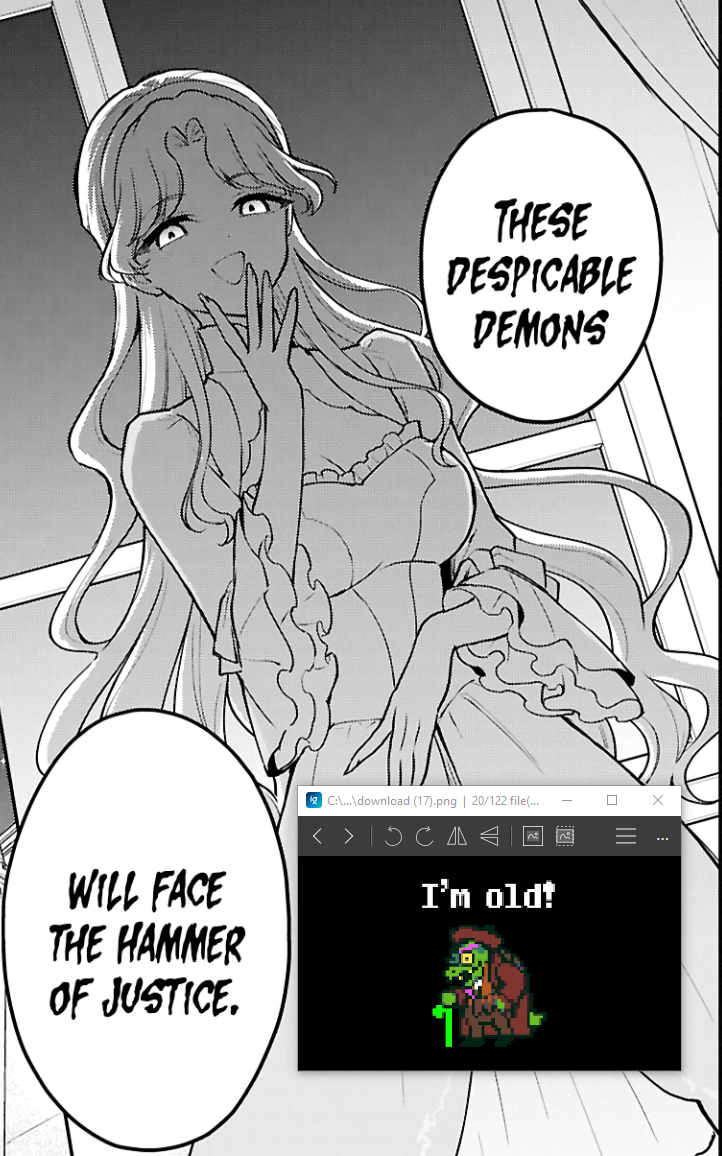
Yeah, dehumanizing bigotry sucks no matter where it's coming from and an endless cycle of retaliatory violence isn't the answer. I don't disagree that that's human nature, either.
BUT. Unless the story so far is lying to us, the hero's kills have been in service of defending against an invading enemy that is explicitly genocidal, killing all humans in the territory it takes. Including everyone the hero knew.
Killings done in furtherance of and in defense against genocide are absolutely NOT morally equivalent.
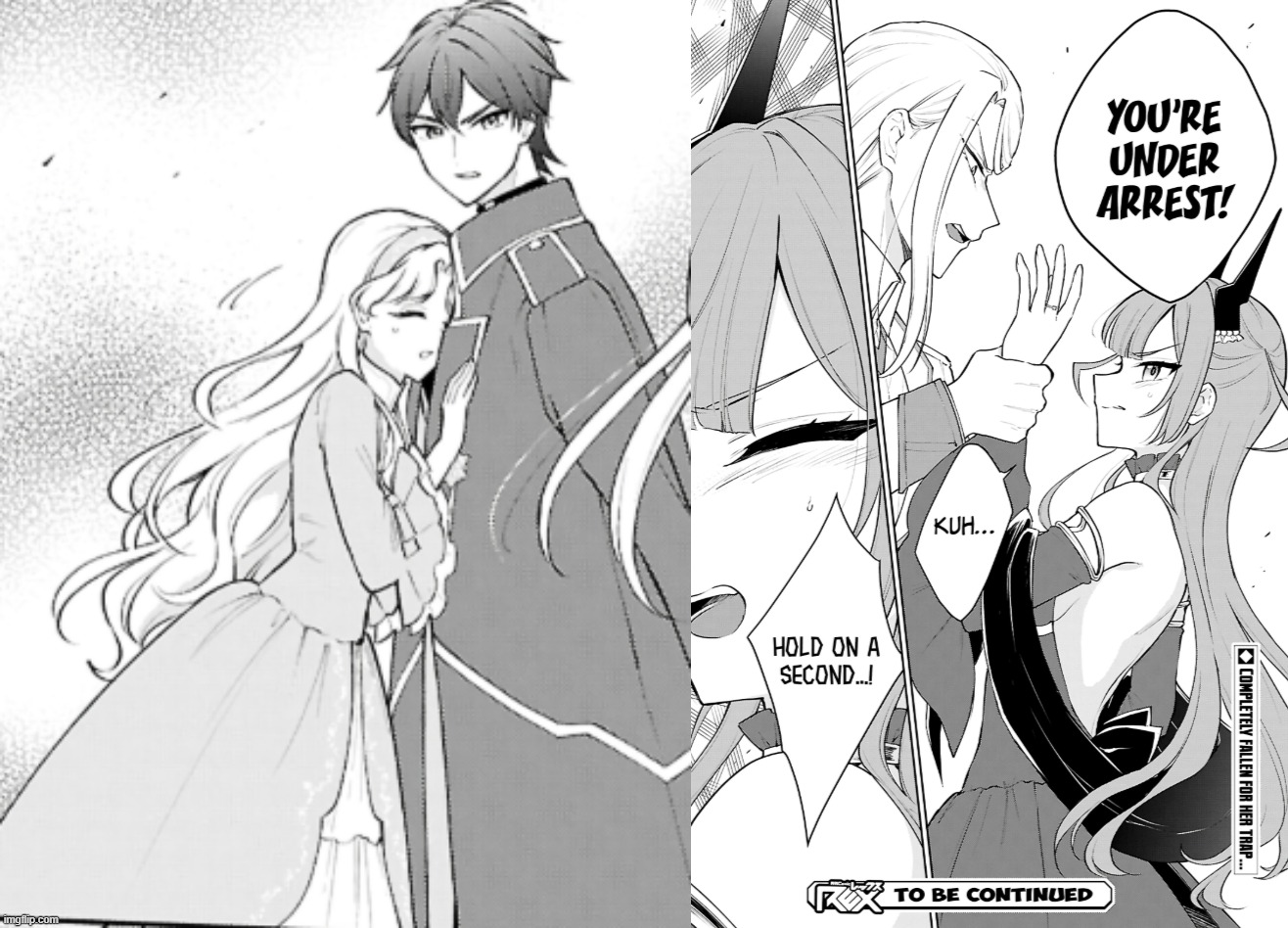
On balance, the hero comes out morally ahead of the demon king's daughter for me, at least so far. He may hate demons, and hate her specifically for the lives she's taken as both personal combatant AND commander, but he's still willing to set that all aside in the name of ending the killings.
The demon king's daughter, on the other hand, has shown no regret for her role in the invasion or any hint at an excuse for (presumably) enthusiastically participating in it. She's shown no indication that she believes human or demon lives have any value. Her only shown motive is an entirely selfish one: She's willing to stop the conflict so that she can marry the hero, whom she loves.
He cares about peace and preserving lives more than he does about revenge.
She cares about pursuing her love more than she does about either peace or war, humans or demons.
She doesn't get a pass just because she's cute and clumsy and getting worked over by a bitch of a princess.
She'll get a pass for reasons yet to be revealed, I'm sure, when her history's explained away and she's revealed not to be a murderous monster or leader of an army that takes no prisoners. Because otherwise she'd be irredeemable.
I know you're getting out in front of the expected twists, but given what we see, let's not "both sides" genocide.
I think that you're making too many assumptions in this argument. It is never stated that demons were attempting genocide, firstly. All that was stated was that the Demon Kingdom attacked the human kingdom, starting a war. If that's the same as attempted genocide, then literally every single war in history is attempted genocide. It's also not stated that the human's force was entirely defensive.
Further, you're trying to make a distinction between the Schmertz's and Liselotte's desires for peace being selfless and selfish, respectively, but that's kind of a bullshit comparison, you know? Like, yes, Liselotte's reason for wanting peace is because she loves Schmertz, but ultimately her end goal and Schmertz's end goal are both "peace." You're saying that Schmertz wants peace because he "cares about peace," but isn't that kind of cyclical? Liselotte also cares about peace. It's just that her reason for doing that is because she loves a human.
We don't really know why Schmertz cares about peace, (at the moment it seems like he just doesn't want humans to die, but even that seems kind of weak) but whatever that reason is,
that is what should be compared to Liselotte's desire to marry him, not just the fact that he cares about peace. Because, again, they both care about peace.
And if you're going to talk about moral superiority, then I'd actually say that Liselotte is the one with the upper hand there! She wants peace because she wants her people to have positive relations with the human kingdom, while Schmertz seemingly only wants peace because he doesn't want his own people to die. He does not care about demons at all, and is not making any effort to actually establish any sort of positive relations between the two. If humans aren't dying, that's good enough for him! Is that really morally superior to a demon that wants peace because she believes in love between the two races?
Anyways, back to the topic of genocide. If anything, the humans seem to be more tending towards that direction than the demons. We've seen time and time again that the humans do not think of the demons as people, and do not seen any value in their lives. And dehumanization is quite famously one of the most significant steps leading to genocide. (Not that I'm actually trying to say that the humans were attempting a genocide of the demons, of course.)
We have not seen this same perspective in reverse from the demon's side; we haven't seen any instances of demons treating humans as less than people as of yet.
Regardless, though, while this story is told from the perspective of a demon, the fact of it being set in the human kingdom means that we have an extremely biased perspective on the relation between the two races. This isn't even an unreliable narrator where the story is "lying to us," as the perspective we have is literally entirely from biased individual humans. And, believe it or not, in fiction, it's totally normal for characters to be biased. That's not dishonest on the author's part, and its definitely not the story "lying."