You are using an out of date browser. It may not display this or other websites correctly.
You should upgrade or use an alternative browser.
You should upgrade or use an alternative browser.
Bouken ni wa, Buki ga Hitsuyou da! ~Kodawari Rudy no Kajiya-gurashi~ - Ch. 20.5 - Every Dungeon Delve Needs Light!
- Thread starter MangaDex
- Start date

Dex-chan lover
- Joined
- Aug 21, 2023
- Messages
- 115
I love the world building in this series
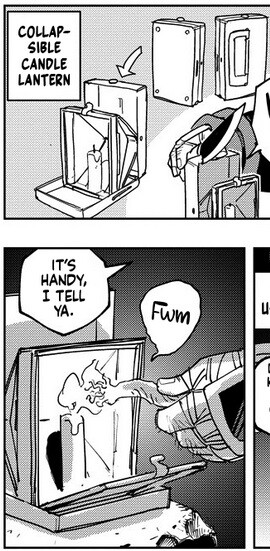
Hello super cool folding lantern, welcome to my dnd homebrew items doc
I think ill go with
Folding Lantern
Adventuring gear 10 gp, ½ lb.
A folding lantern casts bright light in a 15-foot cone and dim light for an additional 45 feet for 1 hour using a normal candle. It can utilized any magic candle that would fit comfortably. This device can fold up to easily fit in a regular pocket, and is water proof while closed.
Thanks for the chapter!
I think ill go with
Folding Lantern
Adventuring gear 10 gp, ½ lb.
A folding lantern casts bright light in a 15-foot cone and dim light for an additional 45 feet for 1 hour using a normal candle. It can utilized any magic candle that would fit comfortably. This device can fold up to easily fit in a regular pocket, and is water proof while closed.
Thanks for the chapter!

Group Leader
- Joined
- Sep 17, 2018
- Messages
- 1,148
It's refreshing to see an author writing reasonable dungeon exploration guides.
Even though it really shouldn't be, it's so refreshing to see.
Especially after nonsense like those guys in that other work claiming you don't need to wear a helmet when exploring dangerous places because monsters can just smack you in the face.
Even though it really shouldn't be, it's so refreshing to see.
Especially after nonsense like those guys in that other work claiming you don't need to wear a helmet when exploring dangerous places because monsters can just smack you in the face.


Dex-chan lover
- Joined
- Apr 13, 2025
- Messages
- 2,377
I love the world building in this series
IKR ? Really enjoying watching an unique world growing bit by bit !!

Dex-chan lover
- Joined
- Jan 17, 2023
- Messages
- 4,236
Dwarven candle hipster. Love it.
Dex-chan lover
- Joined
- Jul 21, 2024
- Messages
- 535
wonder if the author thought of this but didn't put it in because they have no concept of CO2 yet so they just chalk it up to mana shenanigansCO2 can accumulate in confined spaces so a candle can at least tell you there's something wrong with the air around.
Dex-chan lover
- Joined
- Feb 3, 2021
- Messages
- 2,082
Love Crossbow Dwarf and Axe Elf

Dex-chan lover
- Joined
- May 19, 2018
- Messages
- 1,240
Excellent and well thought out short chapter. The science and logistics of lighting in dungeons is actually interesting, and something that most fantasy series don't think about, but I honestly think they should, and works like these show why.
Well acktually...
CO2 poisoning and asphyxiation from lack of oxygen are two different mechanism you can die from in a cave.
The flame test only tests for the presence of oxygen (flame goes from normal -> elongates as more distance required to consume required amount of oxygen -> dims significantly -> goes out; as oxygen decreases)
You don't want to proceed any further as the flame gets too dim...
It is possible for CO2 to accumulated in cold, still and low places as CO2 is heavier than all the other MAJOR components of air. However, it is also possible to accumulate a lethal amount without displacing so much oxygen such that the flame test indicates it's dangerous to proceed (the amount of CO2 is required to kill a person is much smaller than the amount of oxygen that needs to be displaced before succumbing to asphyxiation). You can get away with surprising little oxygen (as evidence by people living in high altitudes such as the Tibetan Plateau), but you won't get away with replacing the same volume of O2 with CO2...
Then there's methane, which is the other major gaseous hazard in caves (also typically from rotting material, if not mining). You can definitely use a flame to test for methane, but canaries were preferred historically for some reason....
CO2 poisoning and asphyxiation from lack of oxygen are two different mechanism you can die from in a cave.
The flame test only tests for the presence of oxygen (flame goes from normal -> elongates as more distance required to consume required amount of oxygen -> dims significantly -> goes out; as oxygen decreases)
You don't want to proceed any further as the flame gets too dim...
It is possible for CO2 to accumulated in cold, still and low places as CO2 is heavier than all the other MAJOR components of air. However, it is also possible to accumulate a lethal amount without displacing so much oxygen such that the flame test indicates it's dangerous to proceed (the amount of CO2 is required to kill a person is much smaller than the amount of oxygen that needs to be displaced before succumbing to asphyxiation). You can get away with surprising little oxygen (as evidence by people living in high altitudes such as the Tibetan Plateau), but you won't get away with replacing the same volume of O2 with CO2...
Then there's methane, which is the other major gaseous hazard in caves (also typically from rotting material, if not mining). You can definitely use a flame to test for methane, but canaries were preferred historically for some reason....

Dex-chan lover
- Joined
- May 28, 2019
- Messages
- 3,917
This was really neat!
Thanks for the extra
Thanks for the extra
Dex-chan lover
- Joined
- Aug 21, 2023
- Messages
- 115
I remember a kid in Goblin Slayer who took off his helmet and got a potato sized rock in the back of his skull. What is this dumb series that dares to say that helmets are useless?It's refreshing to see an author writing reasonable dungeon exploration guides.
Even though it really shouldn't be, it's so refreshing to see.
Especially after nonsense like those guys in that other work claiming you don't need to wear a helmet when exploring dangerous places because monsters can just smack you in the face.
Group Leader
- Joined
- Sep 17, 2018
- Messages
- 1,148
I forgot the title (for good reasons, it was garbage) but that chapter went something like:I remember a kid in Goblin Slayer who took off his helmet and got a potato sized rock in the back of his skull. What is this dumb series that dares to say that helmets are useless?
the main character is a kid who just starts adventuring and gets help from a rich lady, she gives him a full set of leather armour complete with shoulder pads, arm and leg protection, boots, etc. Then the guy asks why there is nothing for the head and the lady and the shopkeeper take a couple of pages to build up a nonsensical argument that helmets do not protect you from monsters.
I remember someone in the comment section saying: "that's like saying armour does not protect you because blades can slip between gaps".
Dex-chan lover
- Joined
- Sep 10, 2019
- Messages
- 227
I YES take candle!As us World of Warcraft players know... "You no take candle!"

Dex-chan lover
- Joined
- Jan 11, 2023
- Messages
- 7,341
the flint rod is another case of "yeah, i know the recipe. but it's easier to just buy it than cook it myself." nice

Dex-chan lover
- Joined
- May 12, 2018
- Messages
- 11,422
So, the story behind that is that the candles keep The Darkness at bay. And y'know, kobolds like living in caves and underground. So they make sure their candles are lit. Lots of mean things lurk in the dark.I YES take candle!
Dex-chan lover
- Joined
- Sep 10, 2019
- Messages
- 227
I know, but I have also "liberated" many of their candles for quest completion.So, the story behind that is that the candles keep The Darkness at bay. And y'know, kobolds like living in caves and underground. So they make sure their candles are lit. Lots of mean things lurk in the dark.
Similar threads

- 58
- Replies
- 59
- Views

- 49
- Replies
- 50
- Views

- 8
- Replies
- 9
- Views

- 45
- Replies
- 46
- Views

Users who are viewing this thread
Total: 2 (members: 0, guests: 2)