Since you made me do a double-take and re-examine the cover... it's weird that all of her toes are the same size. It looks like they've been evenly amputated or something.lovely new cover. May shoes never be invented in this dimension.
You are using an out of date browser. It may not display this or other websites correctly.
You should upgrade or use an alternative browser.
You should upgrade or use an alternative browser.
Nani mo Wakaranai - Vol. 1 Ch. 15 - Basement's Secret
- Thread starter MangaDex
- Start date

Dex-chan lover
- Joined
- Nov 10, 2024
- Messages
- 174
Seems they both have good reason to be impressed with each other.
I'd say it's pretty impolite to teleport someone without their consent, but also, it's not like she could just tell him what she was doing.
I'd say it's pretty impolite to teleport someone without their consent, but also, it's not like she could just tell him what she was doing.
Dex-chan lover
- Joined
- Aug 8, 2018
- Messages
- 646
You never want to get too good at drawing feet.Since you made me do a double-take and re-examine the cover... it's weird that all of her toes are the same size. It looks like they've been evenly amputated or something.

Dex-chan lover
- Joined
- Jan 2, 2026
- Messages
- 1,647
That's just an artstyle thing and we don't know if she's like a normal human either.Since you made me do a double-take and re-examine the cover... it's weird that all of her toes are the same size. It looks like they've been evenly amputated or something.
we got fun and gamesWelcome to the jungle Ryota
I heard that'd it would be very profitable...You never want to get too good at drawing feet.

Dex-chan lover
- Joined
- Jan 22, 2018
- Messages
- 733
My first thought as well. It looks too well secured to not be something dangerous.Imagine if it later gets revealed that the sci-fi thingy is a 5000 kilon ton nuke or something 😅

Group Leader
- Joined
- Jan 8, 2023
- Messages
- 142
To be fair, she did say something on p5.I'd say it's pretty impolite to teleport someone without their consent, but also, it's not like she could just tell him what she was doing.

Group Leader
- Joined
- Sep 13, 2018
- Messages
- 98
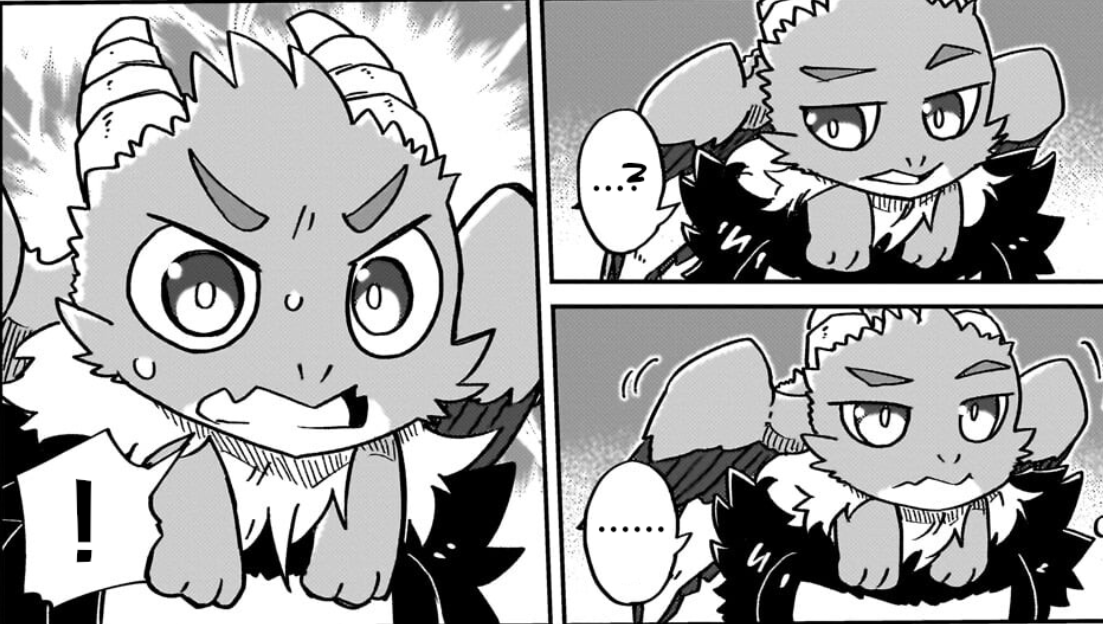
I assume Myaa-san was using her staff to carve a magic circle in the dirt for the teleport spell. Then the dragon looked down and saw the circle and started freaking out.Looks like in the next chapter, MC will explore a new dungeon or some completely different place. As for that dragon bird, for some reason I’m curious why it understands Myaa-san’s teleportation spell chant

Dex-chan lover
- Joined
- Jun 21, 2018
- Messages
- 1,802
Hah. Hearing his full name, bro seriously froze up like he was gonna get this to the back of his head...

(BTW: To give proper credit, that's the logo for the "alter ego" of the local Minor League Baseball team in my home town. For the "Copa de la Diversión" series, the San Antonio Missions become the dreaded "Flying Chanclas". I claim no ownership of the trademark whatsoever.)
(BTW: To give proper credit, that's the logo for the "alter ego" of the local Minor League Baseball team in my home town. For the "Copa de la Diversión" series, the San Antonio Missions become the dreaded "Flying Chanclas". I claim no ownership of the trademark whatsoever.)

Dex-chan lover
- Joined
- Jan 13, 2025
- Messages
- 423
Thanks for the chapter :D
Aww, it's a family outing.
Don't tell me the unknown device is magical warp nexus technology lol
Speaking of which, Miyamutuu seemed to be interacting with some unknown magic when she was casting that spell. She did not recite any incantations this time, so I suspect she either directed the flow of magic with her staff using a magical sixth sense, or interacted with essentially a magical path select dialog box that only she can see.
I'm going to try to break down what Miyamutuu said this chapter: "Mida hihi tyui aii, nimai suimu." I believe we can roughly translate some of this sentence!
This sentence is highly valuable for several reasons:
"Suimu" consists of the characters 'sui' and 'imu;' the former is the most common (and thus possibly flexible?) particle in Myaasanese, and based on previous chapters, the latter probably means both 'yes' and 'me' depending on the context. So, I hypothesize that "suimu" means "to me" or "with me." It's odd for that concept to be a single word, though, so I'm not entirely sure yet.
I looked through the past few chapters, and the character for 'tyui' has been pronounced either as 'tyui' or 'tiya.' Since it was pronounced 'tyui' in Chapter 11's syllabary chart with a different character representing 'tiya,' I'll assume that the 'tiya' pronunciation was a mid-serialization goof or a language quirk that doesn't matter right now.
As for what "tyui" means, I have no idea. I confirmed that "tyui" is a word from Chapter 1, page 15, where it appeared on its own. We also see Miyamutuu saying it in Chapter 4, when she tells Ryouta to stay put.
Unfortunately, we cannot guess at the meanings of "mida" or "hihi," making this sentence's complete meaning untranslatable for now.
Basically, the sentence is something like "[Dependent clause], go with me."
What throws me off is "aii:" even though Myaasanese is almost certainly a subject-object-verb language (with subjects frequently omitted like in Japanese), "aii" consistently appears the end of clauses, after verbs for some reason?? After thinking about it, I also ruled out the theory that it is part of verb conjugation: "mida hihi tyui" is clearly not a verb stem, because dependent clauses with a verb and neither subject nor object make no sense...
While going through previous chapters to analyze this sentence, I reached several conclusions. The first is that "moma sui" probably means "here." It always appears both when Miyamutuu tells Ryouta to stay put and when she beckons him over: "stay here" and "come here" respectively. The second is that "niteni" probably means "to come." We only see this when Miyamutuu beckons Ryouta over to her in Chapter 8, after all.
I have spent the past few hours trying to make things make sense, but I guess I'll admit defeat for now and wait for more information.
Aww, it's a family outing.
Don't tell me the unknown device is magical warp nexus technology lol
Speaking of which, Miyamutuu seemed to be interacting with some unknown magic when she was casting that spell. She did not recite any incantations this time, so I suspect she either directed the flow of magic with her staff using a magical sixth sense, or interacted with essentially a magical path select dialog box that only she can see.
I'm going to try to break down what Miyamutuu said this chapter: "Mida hihi tyui aii, nimai suimu." I believe we can roughly translate some of this sentence!
This sentence is highly valuable for several reasons:
- I believe it is the first time we see the "...aii" syntactic structure used without ending at the end of a sentence. Of course, it still ends a dependent clause here – I'm leaning towards a dependent clause instead of an introductory phrase because the latter half of the sentence is a command.
- This is the second time we see "...aii" outside of the "moma sui... aii" construction. Since "moma sui" has a particle that does not appear in "mida hihi tyui aii," I think it is reasonable to say that "aii" is a word that can stand on its own. This differs from what I previously thought, that "aii" only functioned as a part of a specific sentence structure.
- This is possibly the simplest sentence we have gotten so far in relation to how many different parts of speech it has. So far, most of the dialogue have been either spoken sentence fragments, questions, short commands, or indecipherable complex sentences. None of these are particularly helpful towards either understanding the syntax of Myaasanese. In contrast, this sentence clearly has a dependent clause and an imperative clause, with one imperative verb ("nimai"), one prepositional phrase ("suimu"), likely a subordinating conjunction (somewhere in "mida hihi tyui aii"), and at least one unknown third phrase (somewhere in "mida hihi tyui aii").
"Suimu" consists of the characters 'sui' and 'imu;' the former is the most common (and thus possibly flexible?) particle in Myaasanese, and based on previous chapters, the latter probably means both 'yes' and 'me' depending on the context. So, I hypothesize that "suimu" means "to me" or "with me." It's odd for that concept to be a single word, though, so I'm not entirely sure yet.
I looked through the past few chapters, and the character for 'tyui' has been pronounced either as 'tyui' or 'tiya.' Since it was pronounced 'tyui' in Chapter 11's syllabary chart with a different character representing 'tiya,' I'll assume that the 'tiya' pronunciation was a mid-serialization goof or a language quirk that doesn't matter right now.
As for what "tyui" means, I have no idea. I confirmed that "tyui" is a word from Chapter 1, page 15, where it appeared on its own. We also see Miyamutuu saying it in Chapter 4, when she tells Ryouta to stay put.
Unfortunately, we cannot guess at the meanings of "mida" or "hihi," making this sentence's complete meaning untranslatable for now.
Basically, the sentence is something like "[Dependent clause], go with me."
What throws me off is "aii:" even though Myaasanese is almost certainly a subject-object-verb language (with subjects frequently omitted like in Japanese), "aii" consistently appears the end of clauses, after verbs for some reason?? After thinking about it, I also ruled out the theory that it is part of verb conjugation: "mida hihi tyui" is clearly not a verb stem, because dependent clauses with a verb and neither subject nor object make no sense...
While going through previous chapters to analyze this sentence, I reached several conclusions. The first is that "moma sui" probably means "here." It always appears both when Miyamutuu tells Ryouta to stay put and when she beckons him over: "stay here" and "come here" respectively. The second is that "niteni" probably means "to come." We only see this when Miyamutuu beckons Ryouta over to her in Chapter 8, after all.
I have spent the past few hours trying to make things make sense, but I guess I'll admit defeat for now and wait for more information.

Group Leader
- Joined
- Nov 12, 2018
- Messages
- 1,442
but, do they have everything we want?we got fun and games
I'm going to try to break down what Miyamutuu said this chapter: "Mida hihi tyui aii, nimai suimu." I believe we can roughly translate some of this sentence!
[dissertation starts here]
 THIS is why i love the chapter comments forum threads, and why the inline comments are inferior.
Dex-chan lover
- Joined
- Jun 23, 2019
- Messages
- 797
Feet 😋
New cover!! I don't know why, but I was imagining the baby dragon being blue. But red looks really cool too. On the cover, we can see a bunch of oxen, guinos, or whatever the heck those animals are, along with some wagons. Looks like the merchant/trade stuff is going to be a major theme in this volume.
Similar threads

- 68
- Replies
- 69
- Views
- 39
- Replies
- 40
- Views

- 40
- Replies
- 41
- Views
Users who are viewing this thread
Total: 2 (members: 0, guests: 2)