I 100% that they're not actually evil and believe that there's gonna be some reason that they invaded for some justifiable reason. But those comments are responding to the idea that the hero is in some way wrong for his distrust of demons and the MC, but that's just not true. And really even to us the MC seems to be the only alright demon because what we've seen doesn't seem good either.
You're being contradictory here. You say that you don't think the demons are evil, but at the same time you say that the humans are justified in thinking of all the demons as evil? What?
Anyways, you say this like it somehow contradicts anything I said, but really it doesn't change the fact that these people are insisting that the demons are undeniably the sole aggressor in the conflict and that they are inherently irredeemably evil. They're not saying "Schmertz is justified because
he believes that the demons are evil," they're saying "Schmertz is justified because
the demons are evil." Their actual arguments have nothing to do with him.
Keeping in mind we've literally only seen 4 demons(including the MC, and the demon king who's basically nonexistent at this point) doing things and two of those were: the MC's maid who while caring about the MC, also in the first couple of chapters talks about instilling fear in humans casually and that being powerful enough to wipe out parties and seeing yourself as above everyone else are things to strive for as a demon woman.
Okay, so I've already mentioned this in a comment on a previous chapter, but the whole thing about superiority is very likely just a part of demon culture. It's not strange to think that they'd see establishing oneself as superior and "instilling fear on those beneath you" to be an obligatory point of politeness in the same way doing the
opposite is obligatory in Japanese culture, where it is culturally normal for a person of lower status to speak humbly and subserviently to people socially above them.
This might sound weird to you, but think about the sorts of obligatory marks of politeness in your own culture. In the US, having short hair is basically required for many professions, where long hair is seen as unprofessional. Wearing a suit is similar, where wearing even a slightly off-color suit can be seen as unprofessional and impolite. Honestly, these are kind of more ridiculous than something as simple as "being stronger than the people beneath you." Like, yeah, a person in a position of power should be powerful, shouldn't they?
And in the first place, valuing strength isn't that odd. It's silly to think that that's the mark of an inherently evil society, 'cause you know what? Basically every real life society on Earth values strength. Your culture values strength. My culture values strength. The author's culture values strength. There's a reason that action heroes that beat up a bunch of Nazis are seen as cool, and fundamentally, that's no different from a demon in this setting that beats up a bunch of humans being seen as cool.
And the demons in chapter 3, in the hero's flashback, killing villagers while saying humans are like insects and that it's not so bad to kill them. Those just are objectively not good things.
Also, here: You know that the hero's saying these same things about demons, right? He talks about how awesome he is for killing a bunch of demons and justifies it by saying that the demons are evil and that his slaying of them is just. They're at war, and both sides are killing each other and finding ways to justify it. If you're going to say that the demons are evil for that, then it only makes sense to say that the humans are, too.
And in the first place, the humans we've seen are far more aggressive about this perspective. Practically every single human character we've seen so far as expressed this sentiment, and while we haven't seen many demon characters, none of them have expressed the same in reverse. Further, it was the demons that proposed peace, and that was because a demon fell in love with a human and in spite of the fact that they were both killing each other in the war.
So at the moment, if you're going to talk about the morality of the races based on how they look at and think about the other, then the demons definitely seem to come out on top right now.
Like I said, even though I believe what I said about demons not being evil, until we're shown more demons they've given no reason to believe that the demons weren't the unilateral aggressors.
Anyways, we actually
do have "reason to believe that the demons weren't the unilateral aggressors:"
This is a rom-com between a demon and a human told from the perspective of the demon who is in love with the human, and we see said demon get upset when the human treats her poorly because of his belief that all demons are evil. This is just unambiguously
not the set-up for a story where demons are mindless killers that murdered all the humans for funsies.
Like, you have to take the genre and theme and characters into consideration here, man. I know that its common in modern internet theory culture to ignore everything but raw facts, but that's simply not an effective way to analyze a piece of media. That's how you end up with nonsensical conclusions that are at odds with the story the author's trying to tell. You can't ignore the heart.


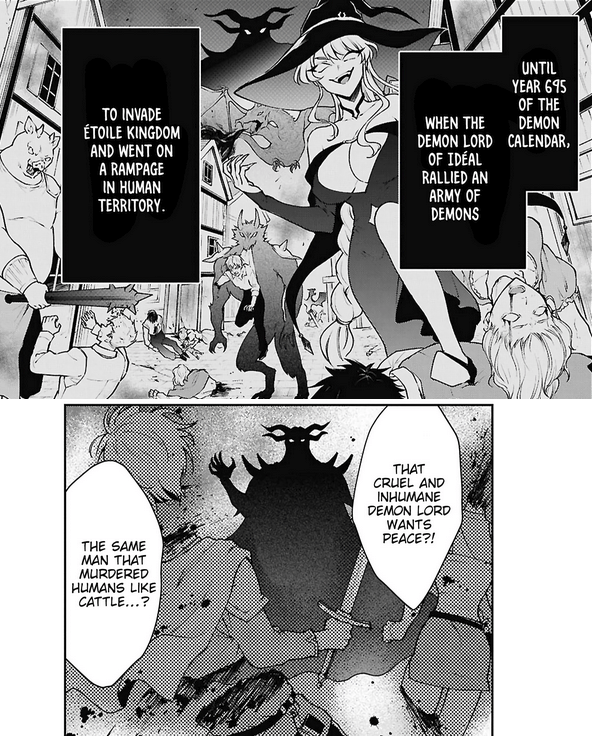

 she even went as far as manipulating the people in the palace to make things go her way.