Nani mo Wakaranai - Vol. 1 Ch. 11 - Numbers and Letters

Dex-chan lover
Joined
Aug 31, 2025
Messages
877
It's not an alphabet, it's a syllabary, just like Japanese kana. Which could tell us a lot about the world he's in if the author put some thought into the worldbuilding, since syllabaries are extremely rare on modern day Earth and Japanese is the only major world language that has syllabic writing.

Or it could also just be the author being lazy about the language he created by making it similar-ish to Japanese, who knows.
It really depends where you put the cursor for a syllabary. Hangeul is technically speaking a syllabary, and even though they aren’t really major languages, you also find syllabaries for Cherokee and a number of Inuit languages. Also Greek used to be written with a syllabary (Linear B).

Moreover, given that every myaa-nese character starting with the same consonant has a common part of the glyph, the script is strictly speaking more of an abiguda, and now that is used by a whole bunch of Indian languages (cf. Devanagari).
:thumbsup:
 
Dex-chan lover
Joined
Feb 14, 2024
Messages
301
It's not an alphabet, it's a syllabary, just like Japanese kana. Which could tell us a lot about the world he's in if the author put some thought into the worldbuilding, since syllabaries are extremely rare on modern day Earth and Japanese is the only major world language that has syllabic writing.

Or it could also just be the author being lazy about the language he created by making it similar-ish to Japanese, who knows.
Technically japanese is not a syllabary but a moraic writing system which is in between alphabet and syllabary.

They have words for example like "today" きょう or "a little bit" ちょっと

In that case these are not syllables anymore because the pronunciation changes (silent vocals) but the signs stay the same. Another example is ōsaka おおさか. Syllable is stretched by writing two signs.

As you mentioned, syllable writing systems are nowadays are extremely rare.
 
Group Leader
Joined
Nov 12, 2018
Messages
1,418
We can finally begin to start translating what’s been said in previous chapters now!

Thanks for the TL
you meant "transcribing", right? because knowing she said "na oup imu" won't let us get the meaning
also, it seems like there's missing letters too (like the "almost a power button" ⏻ thing or the one MC pointed)
 
Dex-chan lover
Joined
Dec 19, 2023
Messages
256
"Isn't the can't-communicate type too original?" Author-san patting himself on the back.
 
Fed-Kun's army
Joined
Jan 3, 2019
Messages
231
Ha!
Love this too.

Diota! ..... like Idiota! .... Idiot! xD

Man i needed that laugh.
 
Dex-chan lover
Joined
Jan 13, 2025
Messages
380
Thanks for the chapter :D

Sorry for being so late; I have been decently busy with IRL stuff the past month so I couldn't get to reading or analyzing. This chapter was a goldmine of information...

Before I start theorizing: my thoughts on the chapter first. I love the self-aware isekai-trope-gag sequence; it was so funny. Myaa-san almost perfectly pronouncing Ryouta was great too; it turns out that she just wants to call him Ryu. She remains the only person calling him Ryu, which must make her very happy.

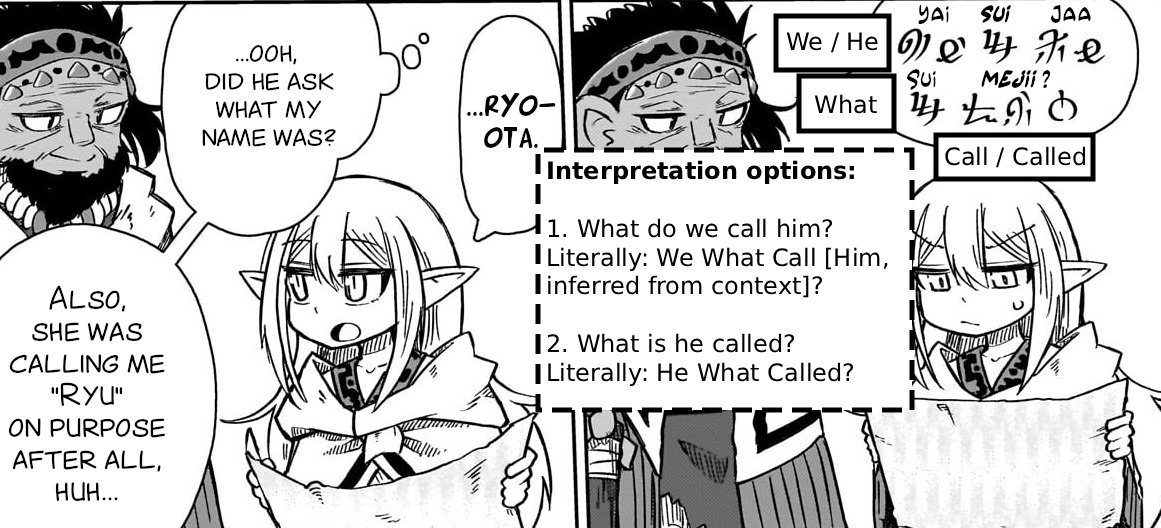
To begin, I had previously thought that "yai sui" meant "we," but after this chapter, I'm beginning to consider the alternative hypothesis of "he/him" or "they/them." Really, both could work.

Nani1.png

The reason why I'm inclined to still think of "yai sui" as "we" is because third-person pronouns are usually omitted in Japanese, instead being inferred from context; including them would actually sound clunky to Japanese speakers. From what I can tell, third-person pronouns seem to be frequently omitted in Myaasanese too: there are plenty of instances when Myaa-san seems to refer to Ryouta in the third person without "yai sui."

However, it should be noted that Myaasanese is absolutely not syntatically identical to Japanese: for example, negation phrases like "oupu" are clearly placed in non-Japanese-like spots. As such, I think both hypotheses are yet to be confirmed. Either way, I think I can pin down "jaa sui" as "what[ever thing]" now – roughly equivalent to nani in Japanese.

Secondly, and very interestingly: I noticed that "ya" as a syllable seems to be missing from the Myaasanese syllabary; instead, its symbol refers to "1" as seen in the math lesson. Yet, it is still incorporated in the pronoun "yai sui". That is weird... Imagine if I started speaking English like this: "any1 know anything about Myaasanese?"

I suppose this lends some credibility to "yai sui" being "he / they" (singular) instead of "we" (plural) but I'm inclined to believe the mangaka followed their Japanese instincts for now.

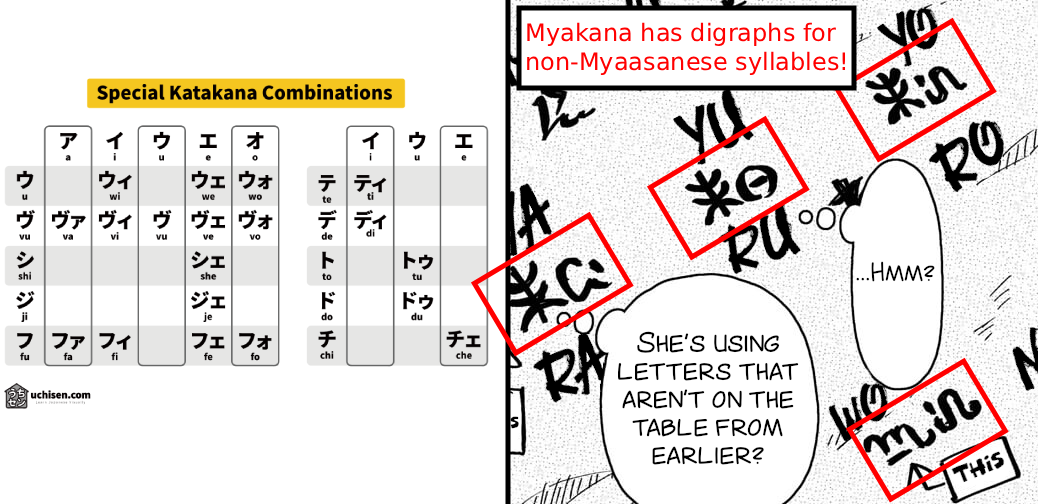
Thirdly, Myaasanese seems to have multiple syllabaries, with one used by natives and the other used to express loanwords and non-native pronunciations. If you know Japanese, think hiragana and katakana. For ease of communication, I'll name the two Myaasanese syllabaries "yakana" and "myakana" – "syllabary 1" and "syllabary 2" – from now on.

We have been shown the entirety of yakana. What really interests me is myakana – the Myaasanese equivalent of katakana, which we saw a bit of. It seems to even involve katakana-like digraphs for expressing non-Myaasanese syllables!

Nani2.png

This is huge because it implies the existence of non-Myaasanese cultures in this world – enough for Myaasanesians to create myakana for loanwords. This is further supported by – as others have mentioned – the existence of the sophisticated mathematical concept "0" and the obvious cultural differences between Miyamutuu and the villagers.
 
Last edited:

Users who are viewing this thread

Top