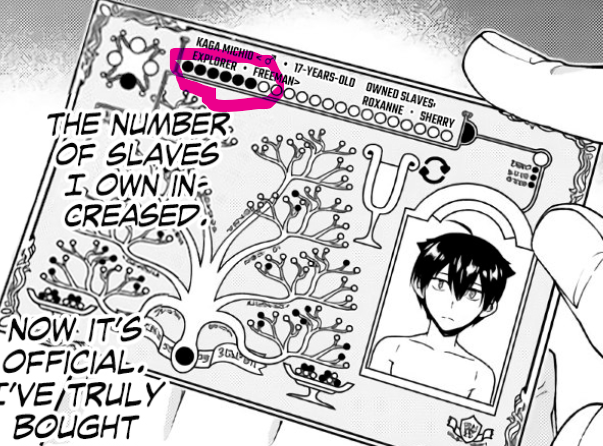
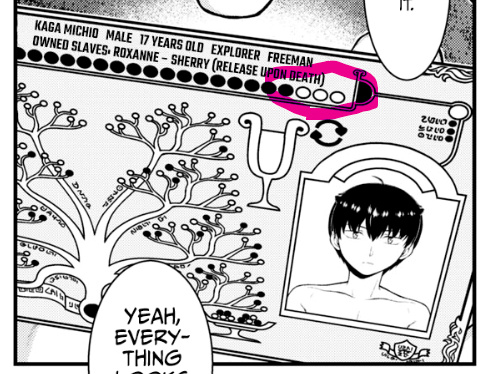
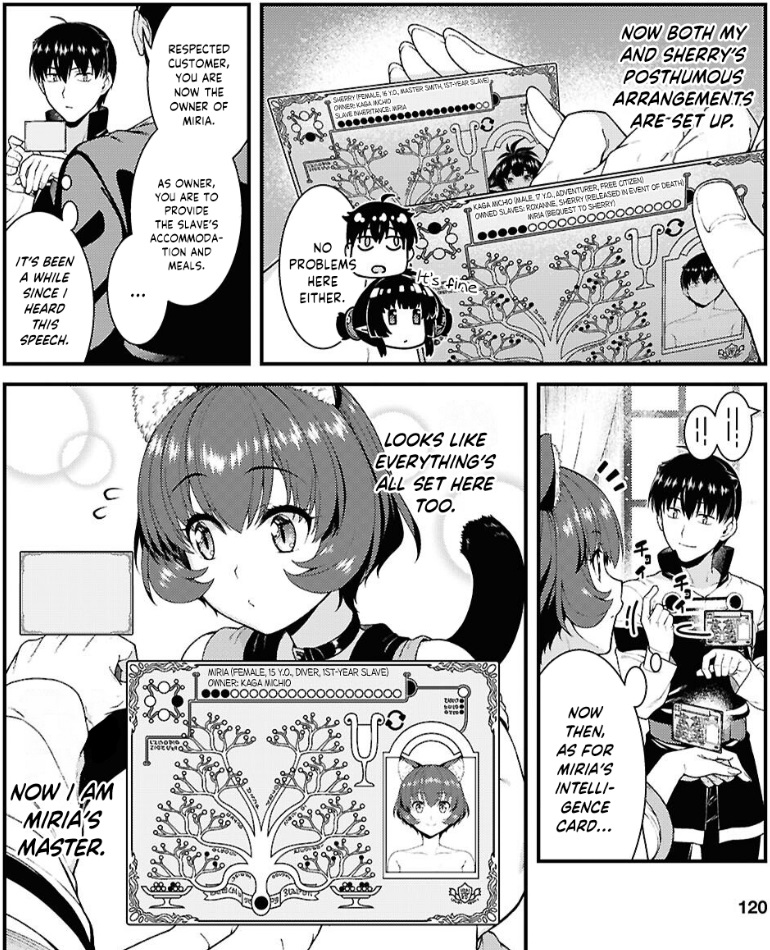
Here's a follow up: What do the people of the world think the bar represents?
There's no way in hell that people all around the world have just ignored the funny bar at the top of their card that follows some sort of pattern but have never questioned it, so if it is a progress bar to the next level then what do they think it is exactly? What would they think it is representing or measuring here?
That's an interesting question.
(Warning: Long)
First, we do know that killing monsters is not the only way to gain XP. Performing actions pertinent to the job (such as a Master Smith crafting gear, or an Herbalist making pills) gains you XP, so there should be progress just from daily living and doing your job. So, if the card is checked in any vaguely regular fashion, the increase in dots should be evident. (Though whether they'd recognize the reset as a "roll-over" event is questionable.)
We can also presume that the people of the world have at least a rough understanding of the tree representing unlocked jobs (as is almost certainly the case). If they know a particular dot represents a particular job, guilds can tell you whether or not you are qualified for a job change to that guild, and Sherry, for example, could tell whether she was able to become a Master Smith relatively easily (just ask the Village Chief to check her card).
Of course I may be jumping the gun on the tree. If the tree represents all unlocked jobs, then Michio would not have been able to hide that he had unlocked Thief when the Knight inspected him, despite it not being his primary job. But maybe that's not quite so unusual? The villager who stole the bandit bandanna could eventually be bought back by his family, and presumably live as a villager again. A kid accidentally getting stuck with a thief job because of a prank should be something that can be fixed.
I was considering reasons the Knight might check the child's card (perhaps for unlocked jobs), but I may actually have to put that on the 'tentative' list.
So we actually have to move a step further back: What reason does anyone have to check an intelligence card in the first place?
1) Check whether your job is Thief/Bandit/Pirate/etc. Various services are forbidden to those jobs.
2) Establish or modify slavery status or contracts.
3) Establish status as a commoner, freeman, noble, etc, for tax purposes.
4) Verify you are who you say you are, and what your current job is in general. (This doesn't come up til much later in the story.)
5) Maybe: Check whether you have unlocked a particular job. It's at least possible at the guilds.
I can't think of any other notable reasons offhand for general examination. If you're not specifically trying to figure things out,
culturally there is little incentive to focus on intelligence cards as anything much beyond a government ID.
Remember that intelligence cards are not
new. Sherry has knowledge passed down through generations. The Knights, the ones you might expect to have the highest amount of interaction with intelligence cards, barely care about them beyond the most minimally necessary engagement. (Perhaps partly influenced through the arrogance of nobility, which seems to be the primary source of Knights.)
One of those knights could easily check the babies' card at any time and see the dots going crazy, it would only take one bored and curious knight to check twice and notice the dots are now wildly different and start asking questions.
And that "curious" is doing some heavy lifting here. Intelligence cards are simply things that are part of this world. People long ago figured out what they are or aren't (as far as accepted wisdom is concerned), just like they figured out that the world is flat and Field Walk involves time travel. (Truth is optional, obviously.)
Someone somewhere
could get curious and start asking questions, but even the smartest person in our story, Sherry, pretty strongly believes in the reliability of most of what she knows. Something as simple as "ice floats on water" is something she doesn't believe til she actually sees it.
So culturally there's not a lot of incentive to be curious; those who are most likely to be curious (such as children) don't have access to view the cards; and the cards don't change frequently enough for a casual review to show much.
But that doesn't answer the question: What
do they think it represents?
Well, next we'd ask, how often do the dots change? We can estimate this using the estimate that it takes about a decade of training as a Warrior before you're qualified to become a Knight. You need to be level 30 Warrior to unlock Knight, so about 10 years to gain 30 levels.
These won't be distributed evenly because it gets harder to level a job as the level increases (but you're also probably fighting on higher levels, so it partly balances out), but on average that's 1 level every 4 months. Maybe a bit less at early levels. 20 dots over 3-4 months is 1 dot every 4-6 days. That's actually similar to my earlier estimate of 1 dot every 3 days (so a full level in 2 months) if you could kill 5 monsters per hour. So something in that range seems reasonable.
What does all that center around? The easiest correlation is the seasonal calendar. Every season is 3 months of 30 days, plus 1 "holiday" day. That is, 3 months, which is right in the estimated range of how quickly you can gain levels. So my first guess would be that it tracks seasonal progression relative to your time of birth.
However this doesn't mesh with the expectation that killing monsters gives you more XP than normal daily activities. Even if adventurers gain dots at roughly the same rates as each other, the difference between that and the normal shop merchant should still raise questions. It's clearly not "just" a calendar.
Still,what else might it be? There's no obvious way to know that it's connected to your current job. A high number of dots doesn't mean someone is stronger than another person with a low number of dots (nor vice versa), so it's not a "measure". It changes fairly regularly (assuming someone is at least doing their job). It repeats.
However they do have the concept of "level", due to the Explorer job. Why do they not connect to that?
On the other hand, the Knights power-leveling a young noble are almost guaranteed to not be raising the child as an Explorer. Much more likely the child will be a Warrior (to eventually become a Knight) or a Wizard, or something similarly prestigious. Since
anyone can become an Explorer, there's no real value in power-leveling that for a noble.
And once again we are stuck at the point where, even if a curious Knight is checking on the child, there's no external evidence that the progression of the dots means anything. Certainly the child won't be getting involved in the actual fighting, and there is no Item Box to look at. The dots may progress a bit faster, but it would already be known that the dots progress faster when you're younger (and lower level), so that may not mean much.
Final answer: I'd guess they view it as some sort of life tracker, progressing at roughly once per season, and it moves faster when you're young.